
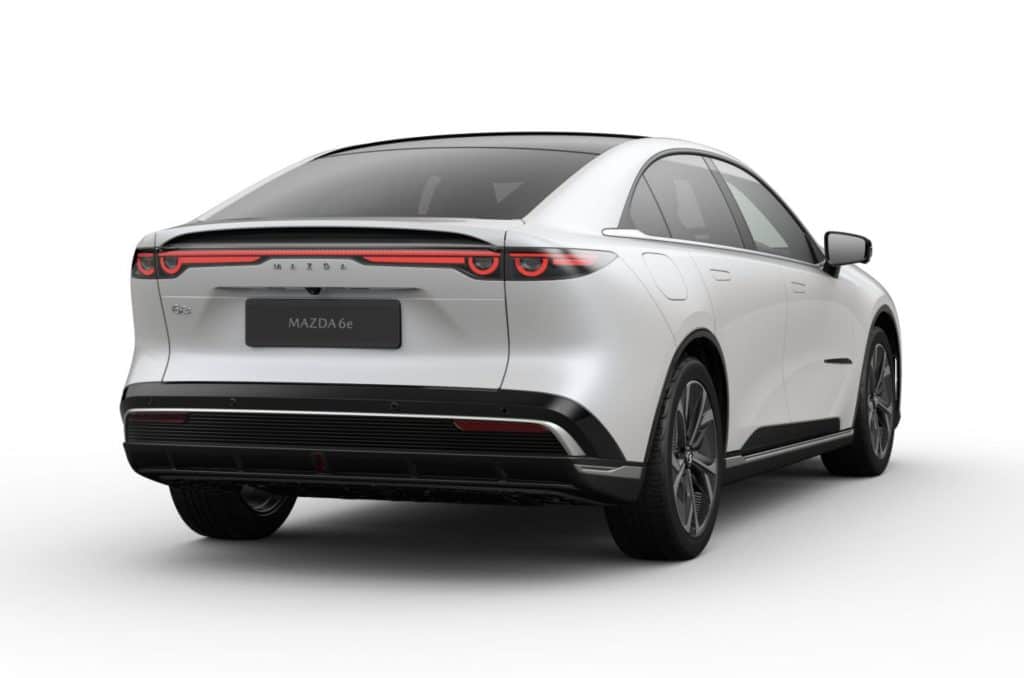
The Mazda6e brings Mazda back into the large family-car conversation with a five-door electric fastback that looks like a saloon but has a practical liftback tailgate. Its low roofline, frameless doors and distinctive illuminated front end give it a more premium appearance than the entry price might suggest. For UK buyers, the appeal rests on elegant design, generous equipment and long-distance potential rather than an extensive choice of powertrains.
The 2026 UK Mazda6e uses one 78 kWh lithium iron phosphate battery and a rear-mounted motor delivering 190 kW (258 PS) and 290 Nm. Both Takumi and Takumi Plus share an official combined WLTP range of up to 348 miles. Mazda quotes a peak DC charging capability of 200 kW, with a 10–80% charge taking about 24 minutes under suitable conditions; that should make motorway stops relatively manageable.
Mazda lists the Mazda6e Takumi at £38,995 on the road, while the more luxurious Mazda6e Takumi Plus costs £39,995. Both versions have a heat pump, a 14.6-inch touchscreen, a 14-speaker Sony audio system and a broad suite of safety and convenience features. The £1,000 upgrade mainly buys a distinctive tan Nappa leather and suede-style interior, an electric blind for the panoramic roof and additional cabin finish details.
The principal UK alternatives include the BYD Seal, Hyundai IONIQ 6, Volkswagen ID.7 and BMW i4. Each offers a different balance of range, charging convenience, cabin controls and driving character. The Mazda deserves attention, but its touchscreen-heavy operating system and real-world motorway range still need careful evaluation on a test drive.
This e-zoomed guide uses Mazda’s July 2026 UK prices and specifications as the primary reference, supplemented by the current UK model page, independent road tests and the 2025 Euro NCAP assessment. The configurator could be opened but did not expose a readable live build quotation, so the published recommended prices are not described as confirmed transaction prices. Earlier European battery options and older UK launch figures are separated from the current British specification throughout.
At a glance
| Feature | Mazda6e — UK 2026 |
|---|---|
| OTR price | Takumi £38,995; Takumi Plus £39,995 |
| EV type | Battery-Electric Vehicle (BEV) |
| Body style | Five-door, five-seat coupé-style fastback/hatchback |
| Drive and performance | Rear-wheel drive; 190 kW (258 PS); 290 Nm; 0–62 mph 7.3 seconds |
| Battery | 78 kWh advertised LFP; UK document does not explicitly separate gross/usable |
| Combined WLTP range | Up to 348 miles for both grades |
| AC and DC charging | 11 kW AC; up to 200 kW DC; 10–80% about 24 minutes |
| Boot and front storage | 337 litres to belt line, 466 litres to ceiling; additional 72-litre front compartment |
| Towing | Up to 1,500 kg braked / 750 kg unbraked |
| Safety | Five-star 2025 Euro NCAP assessment, tested on European 68.8 kWh LHD car |
| Warranty | 6 years/100,000 miles vehicle; 8 years/100,000 miles battery |
| Tailpipe emissions | 0 g/km CO₂ |
Figures relate to the UK July 2026 78 kWh, 258 PS specification, not the earlier 68.8 kWh and 80 kWh European versions. Mazda’s February 2026 UK material quoted 7.9 seconds for 0–62 mph and a 195 kW charger reference; the later July guide states 7.3 seconds and 200 kW. The precise price, paint choice, installed equipment and charge conditions should be confirmed against a current written dealer quotation.
Table of Contents
Pros & cons
| PROS | CONS |
|---|---|
| 1. Refined design and packaging: A sleek five-door body, substantial front compartment and versatile rear hatch give the car useful family appeal. | 1. Screen-heavy controls: Many daily settings are managed through a large touchscreen, which some independent reviewers find distracting. |
| 2. Long official range and quick DC charging: Up to 348 miles WLTP and a 24-minute 10–80% claim suit occasional longer journeys. | 2. Driving feel is mixed: Steering feedback, suspension composure and intrusive driver alerts receive qualified independent assessments. |
| 3. High standard specification: Both trims include heated and ventilated front seats, a heat pump, wireless phone integration and a six-year UK vehicle warranty. | 3. Boot measurements need context: The quoted 466 litres is measured to the ceiling, not the smaller conventional belt-line volume of 337 litres. |
Sign up to the e-zoomed Electric Living newsletter
About Mazda: The company behind the Mazda6e
Mazda is a Japanese vehicle manufacturer whose family-car history includes the Mazda 626 and several generations of the Mazda6. Known for its Kodo design philosophy and emphasis on driving feel, the company has been more measured than some rivals in its transition to electric-only products. The Mazda6e gives it a new presence in the UK’s large electric saloon and fastback class, alongside its wider mix of petrol, hybrid and electric vehicles.
The Mazda6e was developed through Mazda’s long-standing Chinese joint-venture relationships, sharing important architecture with the Changan Deepal family. However, Mazda has adapted aspects of the European car, including suspension, steering and braking calibration, for local markets. Its Japanese-inspired exterior and cabin design remain recognisably Mazda, while the control philosophy differs noticeably from the company’s older, button-rich interiors.
UK buyers receive a single battery and motor combination in Takumi and Takumi Plus grades, even though different battery options appeared in earlier continental European material. That distinction matters when researching used imports, videos or specifications quoted in other countries. For historical background on the model rather than UK pricing, see the Wikipedia overview of the model.
Meet the Mazda6e
The Mazda6e combines the silhouette of a traditional four-door executive saloon with a full-width rear hatch that makes luggage loading more flexible. It measures just over 4.9 metres long and has a 2.9-metre wheelbase, creating generous room for passengers while maintaining a relatively low roofline. The key purchase decision is therefore less about selecting a battery and more about choosing the cabin finish and everyday features that matter most.
Both grades have the same rear-wheel-drive system, 78 kWh advertised battery, range rating and maximum charging capability. Standard equipment is unusually strong, leaving Takumi Plus as an interior-luxury upgrade rather than a meaningful performance improvement. The following review concentrates on the July 2026 UK vehicle and distinguishes certified figures from manufacturers’ claims, independent observations and illustrative calculations.
Overview
Mazda’s Kodo styling is particularly apparent in the Mazda6e’s flowing flanks, illuminated front signature and slender rear light bar. The frameless doors and electrically deployable rear spoiler make it visually distinctive without giving up the functionality of a five-door hatchback. Standard 19-inch aerodynamic alloy wheels reinforce the executive-car appearance, although the low profile and substantial length mean tight city parking deserves a practical trial.
The cabin uses a floating central console, restrained detailing and a large panoramic glass roof to create a spacious feel. Mazda supplies black or optional stone Maztex upholstery in Takumi, while Takumi Plus changes to tan Nappa leather and artificial-suede woven fabric. The more expensive version also adds an electrically operated glass-roof sunshade, a useful consideration for passengers sensitive to bright light and heat.
Both versions are generously equipped with a 360-degree parking-camera system, powered tailgate, head-up display, electric heated and ventilated front seats and a heat-pump climate system. The driver’s environment is modern but more dependent on touch and voice operation than older Mazdas. Buyers moving from a conventional Mazda saloon should experiment with the lights, climate settings and assistance controls during a realistic test drive before judging usability.
Battery & range
The UK Mazda6e is equipped with a 78 kWh lithium iron phosphate battery and a single rear-mounted electric motor. Mazda quotes up to 348 miles on the combined WLTP test cycle for both trims, with a city-cycle figure of 436 miles under laboratory conditions. The manufacturer’s July price and specification guide labels 78 kWh as battery size but does not state explicitly whether that is gross or usable energy.
The July UK guide lists combined consumption at 16.1 kWh per 100 km, approximately 25.9 kWh per 100 miles. This is a standardised test figure, not a promise for a particular journey. Motorway speeds, a cold battery, winter heating and heavy loads can increase consumption, while lower-speed city driving may be more efficient. For route planning, the usable distance between charging stops matters more than the headline full-to-empty range.
Earlier European Mazda6e specifications described a 68.8 kWh lithium iron phosphate battery and an 80 kWh nickel-rich alternative. Mazda has since simplified the British line-up to the 78 kWh pack, making overseas charging curves and range figures unsuitable for the current UK car. An independent technical estimate of roughly 77 kWh usable exists, but it is not identified as an official usable capacity in the supplied July UK document.
On longer journeys, the official range is a credible starting point, although a prudent driver should retain a reserve for diversions, hills and charger availability. The Volvo ES90 offers a different, more premium take on the electric executive-car brief. Comparisons should reflect each car’s actual UK derivative and price rather than selectively matching one model’s best range with another’s entry-level cost.
Charging
According to the manufacturer’s July 2026 UK data, the Mazda6e accepts up to 200 kW DC charging through a CCS connection. Mazda quotes 24 minutes for a 10–80% session and 15 minutes for 30–80%, both on an appropriately powerful charger under favourable conditions. These are different charging windows, not contradictory times; battery temperature, battery state of charge and actual charger output will affect the result.
For routine use, the car has an 11 kW AC onboard charger when connected to a suitable three-phase supply. A common UK single-phase wallbox may deliver roughly 7.2–7.4 kW instead, and Mazda quotes 11 hours 48 minutes from 0% to 100% at 7.2 kW. Our beginner’s charging guide explains why a correctly installed home charge point is generally preferable to regular use of a domestic three-pin socket.
The published 78 kWh battery figure can be used to illustrate electricity cost, with the important qualification that precisely usable capacity is not independently confirmed. If 78 kWh were added to the battery at an illustrative 90% wall-to-battery efficiency, the property would supply about 86.67 kWh. At a hypothetical 25p/kWh that is £21.67; actual cost depends on the amount added, tariff, losses and charging conditions.
On motorway trips, a charger labelled 350 kW will not make the car exceed its own 200 kW peak, and charge power generally tapers as the battery fills. The CCS connector guide and EV charging-time guide explain the practical constraints. Mazda provides a Mode 3 Type 2 AC cable, while a suitable rapid charger normally has its own permanently attached DC cable.
Practicality
The Mazda6e is 4,921 mm long, 1,890 mm wide without mirrors and 1,485 mm high, on a 2,895 mm wheelbase. Its relatively generous rear legroom supports everyday family travel, while the hatchback opening is more flexible than a conventional saloon boot aperture. However, the low coupé-style roofline may make getting into the rear seats or carrying tall passengers less convenient than in a boxier estate or SUV.
Mazda publishes several legitimate luggage figures that should not be mixed: 337 litres to the belt line, 466 litres measured to the ceiling including underfloor space, and 1,074 litres with the rear seats folded. The 72-litre front compartment provides additional independent storage, particularly useful for cables or small bags. The 466-litre figure is therefore not the standard VDA belt-line measurement and should never be presented without its qualification.
Practical features include a 60:40 split rear bench, electrically operated tailgate and an electronically extending rear spoiler. Mazda also approves towing up to 1,500 kg with a braked trailer or 750 kg unbraked, subject to vehicle and towbar conditions. The July technical table lists a maximum roof load of zero, so buyers should not assume a conventional roof box or rack is permitted merely because the car is a sizeable hatchback.
Before ordering, check rear child-seat access, available legroom with the front seats in your preferred driving positions and the luggage opening with your own cases or pushchair. The factory-fitted or retailer-installed towbar arrangements should also be verified in writing. Anyone choosing a home wallbox may find our tethered versus untethered charger comparison useful for deciding how conveniently the car can be connected on the driveway.
Technology & equipment
Both UK grades feature a 14.6-inch central touchscreen, 10.2-inch digital instrument display and a windscreen-projected head-up display. Wireless Apple CarPlay and Android Auto, DAB radio, in-car navigation with charging-point route planning and a 14-speaker Sony system are standard. The cabin also offers a 50 W air-cooled wireless phone charger, USB connections, 64-colour ambient lighting and remote functions through Mazda’s compatible applications.
Mazda’s software includes voice commands, gesture controls, over-the-air updates and configurable shortcuts, including two favourite controls on the steering wheel. That breadth of functions creates flexibility but can demand time spent learning the interface. Independent UK testers have criticised the reliance on the main screen for basic vehicle functions, so the ability to access climate, lights and driver-assistance settings quickly should be considered essential rather than a minor preference.
The standard Takumi cabin offers black Maztex upholstery or a no-cost stone alternative, while Takumi Plus brings tan Nappa leather with artificial-suede trim, a two-tone steering wheel, extra wood-effect detailing and an electric panoramic-roof blind. Both have three-stage heated and ventilated front seats and dual-zone climate control with an air-purifying function. The £1,000 upgrade is chiefly about material feel and refinement, not longer range or quicker charging.
Connected services can include charge scheduling, vehicle status, location and digital-key functions, but availability depends on compatible hardware, active accounts and service terms. The July guide refers to a seven-year complimentary period for certain MyMazda connected services; this should not be confused with unrestricted lifetime access to every feature. Ask a retailer to demonstrate the actual registered car and identify which services, applications and subscriptions are included.
Performance
The UK Mazda6e sends 190 kW (258 PS) and 290 Nm to its rear wheels through a single-speed transmission. The July 2026 UK technical table gives a 0–62 mph time of 7.3 seconds and a maximum speed of 109 mph for both Takumi grades. Earlier Mazda UK material quoted 7.9 seconds, so the updated figure should be used for the July specification rather than carrying forward the older launch claim.
Rear-wheel drive contributes to a balanced feel, and the company offers Comfort, Sport and Individual driving modes that vary response, steering assistance and regenerative-braking settings. Independent UK road tests generally find the car quiet and pleasant on a steady motorway, but some report muted steering feedback, a firm edge to the ride and imperfect control calibration. Those opinions vary by route and reviewer and should not be presented as the result of a firsthand e-zoomed road test.
Mazda’s European engineers have worked on steering, braking and suspension calibration, yet a stylish cabin does not guarantee the engaging handling long associated with the brand. A careful buyer should try low-speed urban manoeuvres, broken British road surfaces and a faster dual carriageway. Test the brakes and regenerative settings at different speeds, and assess how often the assistance systems intervene before committing to either grade.
Safety
The Mazda6e received five stars in the 2025 Euro NCAP programme, with 93% for adult occupants, 93% for child occupants, 74% for vulnerable road users and 77% for safety assistance. The vehicle identified in the assessment was a left-hand-drive European 68.8 kWh model rather than the later 78 kWh UK right-hand-drive car. The rating provides valuable model-family evidence, but this tested configuration should remain explicit.
The UK specification includes front, side and curtain airbags, a centre airbag, autonomous emergency braking, rear cross-traffic alerts, blind-spot monitoring, traffic-sign recognition and adaptive cruise control with stop-and-go support. Direct child-presence detection is also part of the safety story. Such systems may reduce particular risks, but they do not replace careful driving, correctly fitted restraints or attention to road and weather conditions.
Euro NCAP reported strong adult and child crash protection, while its published assessment also identifies areas of more limited vulnerable-road-user performance. Drivers should not assume that five stars eliminate every residual hazard. Independent reviews describe some driver-monitoring and lane-assistance alerts as overactive, so inspect which settings can be adjusted and whether their behaviour is comfortable on familiar roads during an authorised test drive.
Mazda’s UK new-vehicle warranty is six years or 100,000 miles, whichever comes first, for qualifying registrations, while the high-voltage battery warranty is eight years or 100,000 miles. The July 2026 material does not clearly specify a separate battery-retention percentage, so none is invented here. The published service guidance gives a maximum interval of 12 months or 12,500 miles, subject to operating conditions and the full warranty terms.
The verdict
The 2026 UK Mazda6e succeeds in making an electric family fastback look and feel more special than many similarly priced cars. Its handsome proportions, luminous exterior details, roomy cabin and generous standard equipment distinguish it from a conventional saloon. The practicality of a proper rear hatch and separate front storage area is particularly useful in a market where sleek styling can otherwise compromise everyday convenience.
At £38,995 for Takumi, the value proposition is credible: both grades include a heat pump, panoramic roof, Sony audio, smartphone integration and several comfort features. Takumi Plus adds appealing interior materials and an electric sunshade, but does not change the powertrain. A buyer focused on function rather than cabin colour and luxury trim may find little reason to spend the additional £1,000.
The headline technical figures are competitive, with up to 348 miles combined WLTP and a rapid 10–80% charge claim of 24 minutes. They do not guarantee a comparable motorway range in winter, however, and chargers rarely deliver their advertised maximum for a whole session. A driveway wallbox, sensible charging reserves and a realistic long-distance plan remain important to get the best from the car.
In everyday practicality, the liftback tailgate, flexible rear seats, 1,500 kg braked towing capacity and 72-litre front compartment are valuable. The luggage figures require interpretation: 337 litres to the belt line is substantially different from 466 litres to the ceiling. Families needing bulky prams, roof-mounted equipment or an especially high rear cabin should confirm their requirements rather than assuming the Mazda fits every use case.
The car’s biggest reservation is control ergonomics. The reliance on a central touchscreen for familiar functions does not suit everyone, and independent assessments are mixed on steering engagement, ride response and driver-assistance calibration. A five-star Euro NCAP result is reassuring, with the qualification that the tested European configuration differs from the current British specification. These are reasons to test the vehicle thoroughly, not automatic reasons to reject it.
The Mazda6e is worth comparing with the Tesla Model 3 and the other fastbacks mentioned earlier, as well as more expensive executive EVs, depending on budget and preferred equipment. Some alternatives emphasise charging networks and software, others cabin controls or driving feel. Compare on-the-road quotes, realistic range, boot measurements and warranty provisions rather than judging the winner from one headline statistic alone.
The e-zoomed view: We would shortlist the Mazda6e Takumi for a buyer who wants an attractively styled, high-specification electric fastback and has access to reliable charging. We would select Takumi Plus mainly for the tan interior, additional trim finishes and powered glass-roof shade. Before ordering, confirm current prices, the exact 78 kWh UK specification, software usability and the car’s suitability for your longest regular journey.
Gallery
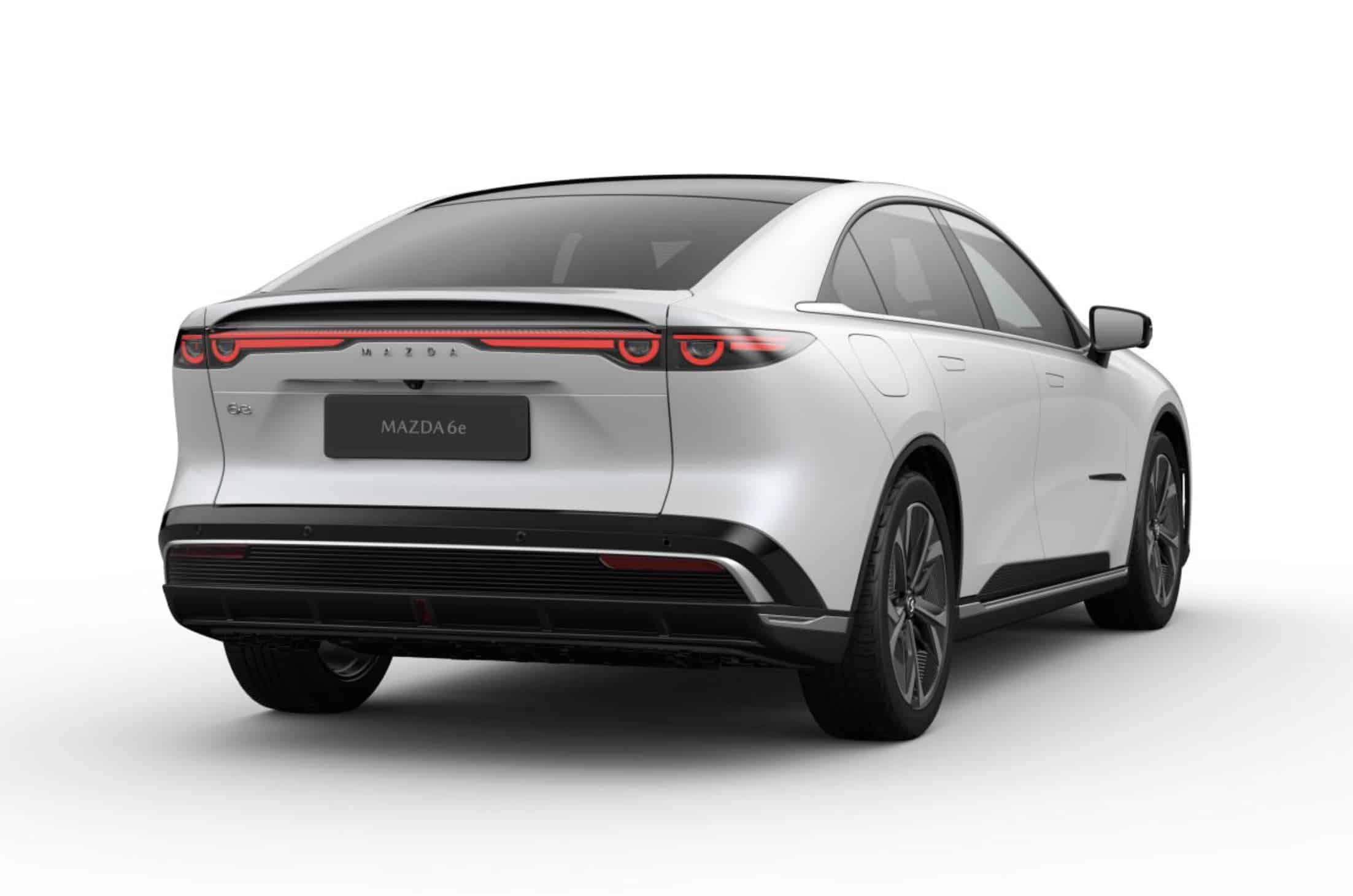
All-Electric Mazda6e (credit: Mazda)
Pricing
Mazda’s July 2026 UK list gives the Mazda6e Takumi a recommended on-the-road price of £38,995, rising to £39,995 for Mazda6e Takumi Plus. These include VAT and the manufacturer’s stated registration-related charges. The published P11D values are £38,930 and £39,930 respectively, which are company-car tax figures rather than an alternative cash purchase price. Discounts, delivery schedules and finance conditions need an up-to-date written retailer quotation.
The principal £1,000 step from Takumi to Takumi Plus adds tan Nappa leather and artificial-suede cabin treatment, decorative trim and the powered panoramic-roof blind. Performance, the 78 kWh battery and 348-mile WLTP rating are unchanged. Crystal White Pearl is listed at no extra cost; other paints are £700, Machine Grey £800 and Soul Red Crystal £1,000 in the July guide. Check actual stock and any changes to options before signing.
The July UK document quotes 4% Benefit-in-Kind for zero-emission company cars in 2026/27, but individual liability depends on tax status and the correct P11D value. Finance and lease comparisons should include deposit, total payable, mileage restrictions and end-of-contract obligations. Buyers contemplating eventual resale may also wish to consult our used-electric-car buying guide for factors such as battery condition and service history.
| UK price or option | Mazda6e Takumi | Mazda6e Takumi Plus |
|---|---|---|
| Recommended OTR | £38,995 | £39,995 |
| Basic price excluding VAT | £32,441.67 | £33,275.00 |
| VAT stated in July guide | £6,488.33 | £6,655.00 |
| P11D value | £38,930 | £39,930 |
| First-year VED and DVLA fee included in OTR | £65 | £65 |
| 2026/27 Benefit-in-Kind rate | 4% | 4% |
| Crystal White Pearl paint | £0 | £0 |
| Other paint finishes | £700–£1,000 depending on colour | £700–£1,000 depending on colour |
| Key cabin difference | Black or stone Maztex | Tan Nappa leather, artificial-suede details and electric roof shade |
Specifications
The four tables below separate the battery and charging facts, illustrative electricity expenses, physical dimensions and the two UK Mazda6e trim grades. Both Takumi derivatives use the same powertrain and share the same official combined WLTP figure. Overseas Mazda6e battery configurations, older February acceleration values and incompatible boot measurement conventions have not been folded into the current UK specification without clear explanation.
| Battery, Emissions, Charging and Warranty | UK 2026 Mazda6e (both trims) |
|---|---|
| Powertrain classification | Battery-Electric Vehicle (BEV) |
| Advertised battery capacity | 78 kWh; manufacturer UK July guide does not state usable capacity separately |
| Battery chemistry | Lithium iron phosphate (LFP); Mazda UK technical announcements |
| Combined WLTP range | Up to 348 miles |
| City WLTP range | Up to 436 miles (not combined range) |
| Combined WLTP electricity use | 16.1 kWh/100 km (approximately 25.9 kWh/100 miles) |
| AC onboard charger | Up to 11 kW with suitable three-phase supply |
| Published single-phase AC time | 0–100% approximately 11 h 48 min at 7.2 kW |
| Peak DC charging | Up to 200 kW on suitable charger |
| Published DC time, 10–80% | Approximately 24 minutes |
| Published DC time, 30–80% | Approximately 15 minutes |
| Charging connections | Type 2 AC / CCS DC; Mode 3 Type 2 cable included |
| Tailpipe CO₂ | 0 g/km |
| 2026/27 UK company-car BiK | 4%; taxable value differs by trim |
| Euro NCAP | Five stars (2025), tested on 68.8 kWh left-hand-drive European vehicle |
| General UK vehicle warranty | 6 years / 100,000 miles, conditions apply |
| High-voltage battery warranty | 8 years / 100,000 miles; capacity retention threshold not established in supplied UK July guide |
| Published service interval | Up to 12,500 miles / 12 months, subject to driving conditions |
Home-charging examples are deliberately illustrative. They use the 78 kWh advertised battery as a modelled energy addition, 90% wall-to-battery efficiency and a flat hypothetical electricity rate of 25p/kWh, without asserting that 78 kWh is exactly the accessible usable capacity. Actual meter readings, time-of-use tariffs, preconditioning and charging losses determine an owner’s real expenditure; standing charges and other costs are excluded.
| Illustrative UK Home-Charging Cost | Assumption / formula | Illustrative amount |
|---|---|---|
| Advertised battery | Mazda UK headline figure | 78.0 kWh |
| Electricity price | Hypothetical, not a live tariff quote | £0.25 per kWh |
| Charging efficiency | Assume 10% energy losses | 90% |
| Modelled energy added to battery | Illustrative 0–100% addition | 78.00 kWh |
| Modelled wall energy | 78 ÷ 0.90 | 86.67 kWh |
| Modelled wall cost | 86.666… × £0.25 | £21.67 |
| Modelled 10–80% battery addition | 78 × 70% | 54.60 kWh |
| Modelled 10–80% wall energy | 54.6 ÷ 0.90 | 60.67 kWh |
| Modelled 10–80% home cost | 60.666… × £0.25 | £15.17 |
| Modelled 30–80% battery addition | 78 × 50% | 39.00 kWh; not Mazda’s actual DC tariff |
| Dimensions and Practicality | UK Mazda6e |
|---|---|
| Body / doors / seats | Five-door fastback hatchback; five seats |
| Overall length | 4,921 mm |
| Width excluding mirrors | 1,890 mm |
| Width including open mirrors | 2,156 mm |
| Overall height | 1,485 mm |
| Wheelbase | 2,895 mm |
| Unladen ground clearance | 148 mm (between axles) |
| Turning circle wall to wall | 11.6 metres |
| Boot to belt line including underfloor | 337 litres (VDA) |
| Boot to ceiling including underfloor | 466 litres (not belt-line measure) |
| Rear seats folded | 1,074 litres, according to Mazda’s UK guide |
| Front luggage compartment | 72 litres |
| Rear seating | 60:40 split; five-seat passenger configuration |
| Towing limits | 1,500 kg braked / 750 kg unbraked |
| Maximum permitted roof load | 0 kg in July UK technical guide; do not assume roof-rack approval |
| Kerbweight | 2,015 kg minimum excluding driver; 2,090 kg listed including driver |
| Wheels | 19-inch aerodynamic alloys, 245/45 R19 tyres |
| Powertrain and Performance by Variant | Mazda6e Takumi | Mazda6e Takumi Plus |
|---|---|---|
| UK battery | 78 kWh advertised LFP | 78 kWh advertised LFP |
| Powertrain layout | Single rear motor; rear-wheel drive | Single rear motor; rear-wheel drive |
| Peak output | 190 kW / 258 PS | 190 kW / 258 PS |
| Maximum torque | 290 Nm | 290 Nm |
| 0–62 mph | 7.3 seconds (July guide) | 7.3 seconds (July guide) |
| Top speed | 109 mph | 109 mph |
| Transmission | Single-speed automatic | Single-speed automatic |
| Combined WLTP range | 348 miles | 348 miles |
| Max AC input | 11 kW | 11 kW |
| Max DC input | 200 kW | 200 kW |
| DC 10–80% time | 24 minutes on suitable 200 kW charger | 24 minutes on suitable 200 kW charger |
| Standard upholstery | Black Maztex; optional stone at no charge | Tan Nappa leather and artificial-suede woven trim |
| Panoramic roof | Tinted glass; no powered shade listed | Tinted glass with powered shade |
| Recommended OTR | £38,995 | £39,995 |
| Earlier 7.9-second claim | Superseded by July 2026 7.3-second specification | Superseded by July 2026 7.3-second specification |
For UK buyers, the relevant choice is Takumi versus Takumi Plus, not an overseas standard-range versus long-range battery combination. Mazda’s July figures take precedence over earlier UK launch announcements where they differ on acceleration or the charger reference. If comparing a used import or pre-registration vehicle, confirm its actual battery pack, steering configuration, software, warranty and charging capability rather than assigning the UK specification automatically.
FAQs
| Question | Answer |
|---|---|
| What does the Mazda6e cost in the UK? | The July 2026 recommended on-the-road prices are £38,995 for Takumi and £39,995 for Takumi Plus, before any retailer-specific deal or paint premium. |
| Does the UK car have two battery sizes? | No. Both current UK grades in Mazda’s July 2026 guide use the same 78 kWh LFP battery. Earlier continental European battery options should not be imported into the UK specification. |
| What is the official driving range? | Up to 348 miles on the combined WLTP cycle. The 436-mile city-cycle figure is a separate laboratory measure. |
| How quickly can the Mazda6e rapid-charge? | Mazda lists up to 200 kW DC, roughly 24 minutes from 10–80% or 15 minutes from 30–80% in suitable conditions. |
| Can it charge at home? | Yes. It supports 11 kW AC on suitable three-phase power. The published 7.2 kW single-phase 0–100% time is about 11 hours 48 minutes. |
| How big is the boot? | 337 litres to the belt line, or 466 litres measured to the ceiling including underfloor storage; a separate 72-litre front compartment is also provided. |
| Can it tow a trailer? | Mazda specifies 1,500 kg braked and 750 kg unbraked limits, subject to the approved towing equipment and vehicle documentation. |
| What is the difference between Takumi and Takumi Plus? | Both share the battery, motor and range. Takumi Plus adds tan Nappa/suede-style trim, distinctive cabin finishes and an electric panoramic-roof shade. |
| Is it rear-wheel drive? | Yes. Both UK trims are rear-wheel drive with a single rear-mounted 190 kW motor and 290 Nm of torque. |
| What safety rating does it have? | Five stars from the 2025 Euro NCAP assessment. The tested vehicle was a European 68.8 kWh left-hand-drive version, not the later 78 kWh UK car. |
| How long is the warranty? | The UK vehicle warranty is six years or 100,000 miles, and the high-voltage battery warranty eight years or 100,000 miles, subject to terms. |
| Why do older sources say 7.9 seconds to 62 mph? | Mazda’s earlier UK communications quoted 7.9 seconds. The later July 2026 UK specification and Mazda media pack state 7.3 seconds for the current 258 PS car. |
While e-zoomed uses reasonable efforts to provide accurate and up-to-date information, some of the information provided is gathered from third parties and has not been independently verified by e-zoomed. While the information from the third party sources is believed to be reliable, no warranty, express or implied, is made by e-zoomed regarding the accuracy, adequacy, completeness, legality, reliability or usefulness of any information. This disclaimer applies to both isolated and aggregate uses of this information.
Featured Articles
<!–
Carousel
–>
BYD Battery-Box HVB Home Battery Storage: UK Price, Specifications, Solar & EV Charging Guide
The Mazda6e brings Mazda back into the large family-car conversation with a five-door electric fastback that looks like a saloon but has a practical liftback tailgate. Its low roofline,…
Peugeot 408 Plug-In Hybrid: UK Prices, Specs, Range & Buying Guide
The Mazda6e brings Mazda back into the large family-car conversation with a five-door electric fastback that looks like a saloon but has a practical liftback tailgate. Its low roofline,…
All-Electric Citroën ë-C4 X: UK Prices, Specs, Range & Buying Guide
The Mazda6e brings Mazda back into the large family-car conversation with a five-door electric fastback that looks like a saloon but has a practical liftback tailgate. Its low roofline,…
Featured Products
-
<!–
–>Sale!
Best-In-Class Home Solar Bundle Offer (440W All Black Jinko Solar 8 Panels + Sungrow Hybrid Inverter 3.6 kW): price includes product supply only
<!– –>
Original price was: £2,205.95.£2,150.95Current price is: £2,150.95. (Including VAT)
<!–
–>
<!– Term:
NEDC range:
Model Year:
Deposit: £
Miles Per AnnumSubject to status and conditions –>
Brand:SungrowJinko SolarCategory:Solar<!– –>
-
<!–
–>Sale!
Best-In-Class Home Solar Bundle Offer (440W All Black Jinko Solar 8 Panels + Sungrow Battery Storage 6.4 kWh + Sungrow Hybrid Inverter 3.6 kW): price includes product supply only
<!– –>
Original price was: £5,010.95.£4,800.95Current price is: £4,800.95. (Including VAT)
<!–
–>
<!– Term:
NEDC range:
Model Year:
Deposit: £
Miles Per AnnumSubject to status and conditions –>
Brand:SungrowJinko SolarCategory:Solar<!– –>
-
<!–
–>Sale!
Bundle Offer: SUNSYNK LifePO4 Home Battery Storage (5.32 kWh) + SUNSYNK Hybrid Inverter (3.6 kW/Single-Phase): price includes product supply only
<!– –>
Original price was: £3,345.95.£3,299.95Current price is: £3,299.95. (Including VAT)
<!–
–>
<!– Term:
NEDC range:
Model Year:
Deposit: £
Miles Per AnnumSubject to status and conditions –>
Brand:Sun SynkCategory:Battery Storage<!– –>
-
Bundle Offer: Tesla Powerwall 3 Home Battery Storage (13.5 kWh) + Gateway: price includes product supply only
<!– –>
£8,559.95 (Including VAT)
<!–
–>
<!– Term:
NEDC range:
Model Year:
Deposit: £
Miles Per AnnumSubject to status and conditions –>
Brand:TeslaCategory:Battery Storage<!– –>
-
<!–
–>Sale!
Custom-Made Single-Phase EV Charging Cable Type 2 to Type 2 (2m to 50m, 7.4 kW, 32 amp, Black)
<!– –>
Price range: £99.95 through £670.95 (Including VAT)
<!–
–>
<!– Term:
NEDC range:
Model Year:
Deposit: £
Miles Per AnnumSubject to status and conditions –>
Category:CablesType:Type 2Length (m):5 m7.5 m10 m3.5 m12.5 m15 m20 m17.5 m2 m22.5 m25 m30 m35 m40 m45 m50 mCurrent (amp):32 ampPhase:Single Phase (7.2kW)<!– –>
This product has multiple variants. The options may be chosen on the product page -
Untethered Ohme ePod Home Smart EV Charger (7.4 kW): price includes product only
<!– –>
£645.95 (Including VAT)
<!–
–>
<!– Term:
NEDC range:
Model Year:
Deposit: £
Miles Per AnnumSubject to status and conditions –>
Brand:OhmeCategory:EV Charging PointsCustomer type:ResidentialPower:7.4 kWCable:UntetheredPhase:Single Phase<!– –>

The post All-Electric Mazda6e (2026): UK Prices, Specs, Range & Buying Guide appeared first on Ezoomed.