
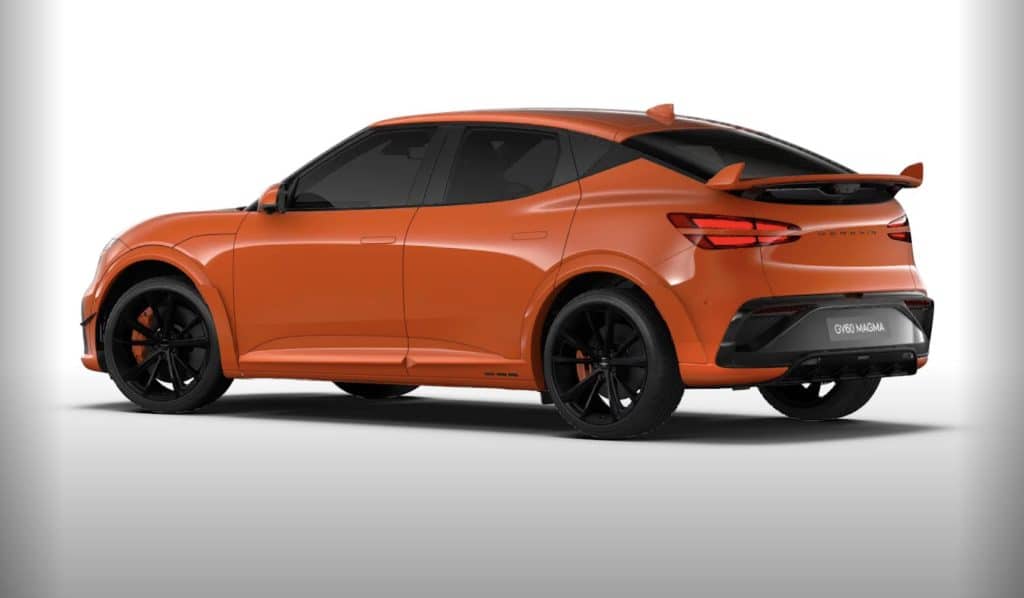
The Genesis GV60 Magma is the first production model to wear Genesis’s new high-performance Magma identity. It takes the distinctive shape of the regular Genesis GV60 and adds substantially more powerful dual motors, wider bodywork and performance-focused chassis tuning. The result is a premium battery-electric crossover that aims to combine dramatic acceleration with genuine long-distance comfort rather than behaving like an uncompromising track car.
UK pricing starts at £75,915 on the road for a single Magma grade. An 84 kWh advertised battery, dual-motor all-wheel drive and 264-mile combined WLTP range underpin the specification. Genesis gives the motors a regular maximum combined output of 448 kW (609 PS), rising temporarily to 478 kW (650 PS) and 790 Nm in Boost mode. The headline 0–62 mph time is 3.4 seconds when the appropriate performance conditions are met.
Rapid charging is an important part of the package: the manufacturer quotes 10–80% in approximately 18 minutes at a suitable 350 kW DC charging station, with the car itself accepting up to about 265 kW in ideal conditions. Those figures describe a well-prepared battery and a specific charging window. They should not be interpreted as an 18-minute zero-to-full session or proof that every public charger can deliver the required power.
The most relevant performance alternatives include the Hyundai IONIQ 5 N and Kia EV6 GT, while the Polestar 4 and BMW iX3 illustrate different approaches to premium electric travel. Compared with the regular Genesis GV60, Magma sacrifices some range and everyday ride softness to gain exceptional performance. Buyers should compare actual UK derivatives, driving comfort, charging convenience and full transaction prices rather than headline output alone.
This e-zoomed guide uses the current Genesis UK Magma page, dated UK manufacturer specifications, the UK warranty terms and independent first-drive findings checked on 27 November 2026. The manufacturer’s interactive configurator could be reached, but a personalised specification and final price could not be independently extracted. We therefore distinguish confirmed UK facts from independent estimates, other-market technical details and features that still need verification against a specific vehicle.
At a glance
| Feature | Genesis GV60 Magma — UK 2026 launch / MY27 designation |
|---|---|
| UK price | From £75,915 OTR; one Magma grade, optional paint may add cost |
| EV type | Battery-Electric Vehicle (BEV) |
| Body style | Five-door, five-seat high-performance crossover/SUV |
| Motor / drivetrain | Dual electric motors, all-wheel drive |
| Output | 448 kW / 609 PS normal maximum; 478 kW / 650 PS temporary Boost |
| Torque | 740 Nm normally; 790 Nm with Boost |
| Battery / official range | 84 kWh advertised; up to 264 miles combined WLTP |
| Acceleration / top speed | 0–62 mph 3.4 seconds with Boost; maximum 164 mph |
| Charging | 11 kW AC; up to approximately 265 kW DC; 10–80% about 18 minutes |
| Cabin | 27-inch panoramic display, 10-way sport seats, Magma performance controls |
| Warranty | Vehicle 5 years/unlimited mileage; battery 8 years/100,000 miles for private use, terms apply |
| Tailpipe emissions | 0 g/km CO₂ |
Prices and key performance figures reflect the UK Genesis model page and manufacturer information published in February, May and August 2026. The UK page quotes up to 265 kW DC whereas Genesis’s German specifications round the peak to 264 kW; neither value is a sustained charging rate. The advertised 84 kWh is not separately certified as usable energy by these UK sources; an independent usable-capacity estimate is approximately 80 kWh.
Table of Contents
Pros & cons
| PROS | CONS |
|---|---|
| 1. Extraordinary controlled performance: Dual motors deliver 650 PS and 790 Nm temporarily in Boost, supported by specialist brakes, tyres and chassis systems. | 1. Range is a major compromise: Up to 264 miles WLTP is well behind more comfort-focused electric crossovers, particularly with spirited driving. |
| 2. Extremely rapid charging: The quoted 18-minute 10–80% DC session and 800-volt-class architecture can make carefully planned journeys practical. | 2. Firmness and weight: Independent drivers report an unforgiving low-speed ride and noticeable mass, especially from the rear seats. |
| 3. Luxury equipment and ownership cover: Sport bucket seats, upgraded audio, a 27-inch display and comprehensive UK warranty support the premium position. | 3. Premium price and operating costs: £75,915 OTR, expensive high-performance tyres and limited efficiency make this a specialist purchase. |
Sign up to the e-zoomed Electric Living newsletter
About Genesis: The company behind the GV60 Magma
Genesis became a standalone luxury automotive brand in 2015 as part of Hyundai Motor Group and entered the UK market in 2021. Its design approach, often described as Athletic Elegance, gives the brand a distinctive alternative to conventional German premium marques. The original all-electric Genesis GV60 helped establish its EV credentials, while the Magma programme marks a more explicit move into driver-focused performance and international motorsport.
The production Genesis GV60 Magma combines Genesis’s luxury positioning with technology developed across Hyundai Motor Group, but its suspension, aerodynamics, performance modes and interior details have been specifically tuned. It is related in architecture to the Hyundai IONIQ 5 N and Kia EV6 GT, not mechanically identical in every detail. Magma is a distinct version rather than a styling pack that simply adds orange trim to an ordinary GV60.
Genesis announced the UK technical specification in February 2026 and confirmed a £75,915 on-the-road starting price in May. UK sales information now lists the model for configuration, although precise delivery dates and optional equipment charges must be checked with an authorised retailer. For general background on the company, see the Genesis Motor overview on Wikipedia; the UK vehicle figures in this review come from manufacturer and independent technical evidence.
Meet the Genesis GV60 Magma
The Genesis GV60 Magma is more than a faster version of a familiar electric crossover. Its lower body, wider track, unique aerodynamic pieces and forged wheels support increased performance, while the cabin introduces an exclusive steering wheel, supportive bucket seats and displays tailored to enthusiastic driving. Nevertheless, the car retains five passenger positions and the basic practicality of a modern compact SUV, making daily suitability a central part of its proposition.
The model is offered in one UK performance specification rather than several motor or battery choices. Buyers choose exterior colour and one of two interior stitching themes, while Boost, GT and SPRINT are selectable operating modes rather than separate vehicle trims. We therefore keep the normal and temporary Boost power outputs distinct throughout the article, particularly in the Specifications tables where competitors are often compared using their highest possible figures.
Overview
The Genesis GV60 Magma has a noticeably lower and wider stance than the standard Genesis GV60, helped by approximately 20 mm less ride height and bespoke wheel arches. There are functional openings in the front bumper, prominent side sills and a full-width rear spoiler intended to manage airflow and lift at speed. Orange brake callipers and 21-inch forged wheels make the performance intent unmistakable, but the changes are principally engineering-led rather than decorative.
Genesis fits wide Pirelli performance tyres and revised chassis components to handle the car’s substantial power. The design has visual confidence without the exaggerated add-ons found on some track-oriented vehicles, although the larger wheels and wider tyres may affect replacement costs and urban ride comfort. Drivers should consider these ongoing expenses alongside insurance and depreciation, not assume that the purchase price covers the complete financial impact of performance motoring.
Inside, the 27-inch integrated display, crystal sphere controller and sculpted sport seats give the cabin a recognisable Genesis identity. Two stitching choices are offered against the dark interior, including Magma Orange and Ash White, while the steering wheel places performance functions close to the driver. The manufacturer also highlights active noise management and additional sound insulation, seeking to preserve its luxury character despite the firmer suspension and wider tyres.
Battery & range
Genesis advertises an 84 kWh battery for the UK Genesis GV60 Magma and a combined WLTP range of up to 264 miles. This is a comparatively modest official distance for a premium electric crossover at its price, reflecting the priorities of higher output, broader tyres and performance-focused aerodynamics. The manufacturer’s 2.9 miles/kWh combined energy-consumption figure is a laboratory reference, not a guarantee for motorway journeys or track use.
An independent EV technical database estimates approximately 80 kWh of usable energy and around 230 miles of mixed-condition range, but the usable figure is not separately confirmed in the UK Magma model page. It should therefore not be inserted as a manufacturer-certified battery capacity. Weather, gradients, tyre temperatures, driving style and sustained speed will influence actual efficiency, with hard acceleration and repeated performance-mode use potentially reducing range substantially.
The quoted 264 miles must also be distinguished from longer-range versions of the regular Genesis GV60. Buyers attracted principally by a luxury electric SUV with maximum distance between charges may be better served elsewhere in the Genesis range or by models such as the Polestar 3. If regular journeys involve remote destinations, consider the number of dependable rapid chargers available and maintain an appropriate battery reserve rather than planning around a full-to-empty WLTP distance.
The battery-management system includes high-performance conditioning to control pack temperature before demanding driving or charging. This can support repeated acceleration and rapid charging, but it does not remove the effects of heat, cold or battery state of charge. In winter, both heating demand and reduced charging acceptance may affect the journey plan; owners should use the vehicle’s navigation and battery-preparation systems early rather than assume peak performance is instantly available.
Charging
The Genesis GV60 Magma uses an 800-volt-class electrical architecture and accepts up to approximately 265 kW DC according to Genesis UK. The manufacturer quotes 10–80% in as little as 18 minutes using a suitable 350 kW charging station and a battery at the appropriate temperature. That does not mean the car can accept 350 kW, nor will it remain near its peak throughout the session; the charging curve and conditions determine the actual stop length.
For routine AC charging, the onboard charger accepts up to 11 kW from a suitable three-phase supply. Most domestic UK wallboxes on a single-phase connection deliver a lower maximum, commonly around 7 kW, so a full charge takes longer. At an illustrative 7.4 kW supply, an independent technical calculation puts a near-empty-to-full session at roughly 12 hours 45 minutes, but installation limits and losses will change that result.
The European charging interface is Type 2 for AC and CCS for rapid DC use. Our CCS rapid-charging guide explains why DC charging connectors and power ratings differ from a home wallbox. Our tethered versus untethered charging comparison helps with the choice of a home cable. High-powered public chargers are concentrated on particular routes and can be busy or unavailable; a robust plan should include an alternative stop and sufficient remaining range, especially before an extended motorway journey.
Charging costs depend on the household or public tariff, not on the car’s headline power. Using the advertised 84 kWh as a transparent modelling input, 90% wall-to-battery efficiency and a hypothetical 25p/kWh electricity price gives about £23.33 for a modelled full energy addition. This is not a manufacturer-certified cost or proof of exactly accessible battery capacity; public ultra-rapid tariffs may be substantially higher than a well-chosen overnight home tariff.
Practicality
The Genesis GV60 Magma retains a five-door, five-seat crossover layout despite its widened bodywork and lowered stance. Genesis’s international dimensions put it at approximately 4,635 mm long, 1,940 mm wide excluding mirrors and 1,560 mm high, with a 2,900 mm wheelbase. These Magma-specific measurements agree with an independent database, but exact UK homologation and mirror-to-mirror width should be checked before relying on them for a narrow garage.
A German Genesis specification quotes 670 litres of luggage space behind the rear seats measured to the roof, while an independent database also gives 670 litres and estimates a small 20-litre front compartment. Those figures should not be compared directly with rival SUVs’ VDA belt-line boot volumes. A UK-specific conventional luggage measurement was not independently established here; buyers should inspect the load floor, parcel-shelf space and their actual luggage rather than assume a particular usable volume.
The rear seats are split-folding and the two outboard positions support child restraints according to platform-level technical information. The elevated crossover seating position helps general access, but the deeper side bolsters of the sport front seats and firmer ride could be less accommodating for some passengers. Independent driving reports also question low-speed comfort in the back, making a realistic family test drive more useful than simply comparing five-seat capacity.
A third-party vehicle database lists towing capability for the Magma, but its figures could not be reconciled with a UK Magma-specific manufacturer certificate. Consequently, no UK-approved braked capacity is asserted in this guide. Anyone intending to tow or fit a roof carrier should request the Certificate of Conformity and accessory approval for the exact vehicle; wide tyres, low suspension and performance bodywork also deserve care on steep driveways.
Technology & equipment
The Magma cabin features a 27-inch panoramic display combining driver information and infotainment, with a performance-specific digital instrument theme. SPRINT mode brings information such as torque, simulated revs and selected virtual gear into greater prominence, while GT mode uses a calmer presentation. The head-up display helps keep essential information within view, although buyers should check which data are genuinely useful and how much attention menu-based functions demand during everyday driving.
The 10-way electrically adjustable sport bucket seats have heating and ventilation together with bolsters that can increase support according to driving mode and speed. High-grade suede-style upholstery, aluminium detailing and ambient lighting provide a more focused atmosphere than the standard Genesis GV60. Genesis also describes active noise cancellation, acoustic measures and an upgraded Bang & Olufsen sound system, reinforcing the intent to blend spirited driving with long-distance refinement.
Virtual Gear Shift introduces simulated gear changes controlled by paddles, accompanied by an engineered soundtrack rather than mechanical engine noise. These effects can make acceleration more involving and may help the driver interpret available power, but they are optional driving sensations rather than a physical multi-speed transmission. The underlying powertrain remains a battery-electric, single-ratio system; owners who prefer quiet linear propulsion should explore how the sound and shift features can be adjusted or disabled.
Genesis advertises active driver assistance, including highway driving support, lane-keeping functions, blind-spot monitoring and emergency braking. Exact standard equipment and software availability should be checked in a current UK specification or on the configured vehicle. Driver-assistance technology is not autonomous driving, and electronic interventions should be assessed during a careful test drive rather than accepted solely because a long feature list appears on the website.
Performance
The dual-motor all-wheel-drive system produces a regular maximum combined 448 kW (609 PS) and 740 Nm. For a short interval, the steering-wheel Boost control increases those figures to 478 kW (650 PS) and 790 Nm, with Genesis quoting up to 15 seconds of peak output. The associated manufacturer 0–62 mph time is 3.4 seconds, while a 164 mph maximum speed demonstrates that the engineering brief extends beyond low-speed launch acceleration.
The suspension and braking systems have been extensively altered from the standard Genesis GV60. Genesis describes electronically controlled damping, torque vectoring, an electronic limited-slip differential and 400 mm front discs with four-piston monoblock callipers. GT mode favours controlled high-speed touring, whereas SPRINT sharpens the car’s response for enthusiastic driving on suitable roads or circuits. Owners should read the warranty’s restrictions on competition and track use before assuming that every circuit session is covered.
Independent first drives broadly praise the explosive acceleration, front-end grip and confidence through bends, while also identifying a stiff urban ride, a relatively soft initial brake-pedal feel and a heavy-car character. These comments are sourced observations, not the result of an e-zoomed road test. Our electric-car torque explainer provides context for the headline 790 Nm figure. Anyone deciding between this and the Kia EV6 GT should test both on imperfect British roads as well as smoother routes, with comfort mode and assistance settings properly explored.
Safety
The regular Genesis GV60 received five Euro NCAP stars in 2022, but the published rating explicitly identifies lower-output GV60 variants and does not list the substantially revised Genesis GV60 Magma. It would therefore be incorrect to present that five-star result as a fresh Magma-specific crash test. The underlying platform provides useful context, but the Magma’s changed structure, performance hardware and mass require model-specific consideration.
Genesis lists a wide range of electronic safety and assistance systems for the Magma, including lane assistance, collision avoidance, adaptive cruise support and surround-view technology. Such systems can reduce risks when functioning correctly, but their behaviour depends on road markings, sensors, weather and the driver’s attention. Performance hardware does not make an SUV immune to the consequences of speed or weight, and owners should understand how braking and assistance settings differ between drive modes.
The current UK Genesis warranty offers qualifying privately used passenger cars five years of vehicle cover with unlimited mileage. The high-voltage battery has separate coverage for eight years or 100,000 miles, with terms allowing repair to restore at least 70% of original battery capacity. Commercial use has different mileage restrictions, and defects connected with racing, competition or improper modifications are excluded. Read the relevant terms carefully before assuming all performance activities receive identical protection.
Genesis additionally offers five years of roadside assistance and an included Care Plan subject to its own service and mileage limits, which must not be confused with the unlimited-mileage vehicle warranty. Child-seat positions, tyre specifications, brake-component costs and insurance exclusions should also be considered before purchase. A premium safety and ownership package is valuable, but it does not remove the need to evaluate real-world maintenance and family usability.
The verdict
The Genesis GV60 Magma is a convincing demonstration of how Genesis intends to combine its luxury identity with serious electric performance. It looks distinctive without abandoning practical five-seat packaging, and its powerful dual motors deliver acceleration that few conventional family SUVs can approach. The strongest argument for buying it is the blend of unusual design, technology and driver engagement, not a claim that it is the most rational electric car.
Its most compelling strengths are the 650 PS temporary Boost function, specialist chassis engineering and rapid DC charging capability. The dedicated GT and SPRINT modes give the driver a choice between a more relaxed or assertive character, while the 27-inch display, sport seats and refined audio contribute to the premium environment. This combination will attract buyers who want performance without losing every familiar luxury convenience.
There are meaningful drawbacks. With up to 264 miles combined WLTP, it has less official range than many cheaper electric SUVs, and aggressive driving will reduce practical distance between charges further. Independent reports are also less enthusiastic about the stiff low-speed ride and some control ergonomics. These shortcomings may matter more in daily British driving than the extraordinary top speed or launch performance.
Charging is comparatively strong when a suitable ultra-rapid charger is available and the battery is correctly conditioned, but the 18-minute 10–80% claim depends on ideal circumstances. Home charging is likely to be more convenient for routine use, and substantial energy consumption makes electricity tariffs relevant to the running-cost calculation. Buyers should also check the boot’s measurement basis and confirm towing requirements rather than relying on generic GV60 figures.
The Polestar 4 and BYD Sealion 7 offer alternative combinations of cabin space, comfort and value, while the Hyundai IONIQ 5 N and Kia EV6 GT speak more directly to the performance buyer. The Magma’s distinct advantage is its Genesis design and ownership approach, not necessarily greater practical ability or superior value on every measure. Direct test drives should settle how much the driving character is worth.
At £75,915 OTR before selected paint choices, this is a considered purchase. The single UK grade is generously specified, with nine exterior colours and two stitching choices, but current finance deals and real dealer lead times should be checked rather than relying on expired promotions. Buyers who drive long distances frequently or carry sensitive rear-seat passengers may be better served by a more comfort-oriented electric vehicle.
The e-zoomed view: We would shortlist the Genesis GV60 Magma for an enthusiast seeking a distinctive high-performance EV with five-seat practicality and access to convenient charging. We would not recommend buying it solely for the 650 PS headline or without driving it over uneven roads. Confirm the model-year specification, warranty conditions, available paint charges and realistic range before committing, then compare it directly with the principal performance alternatives.
Gallery
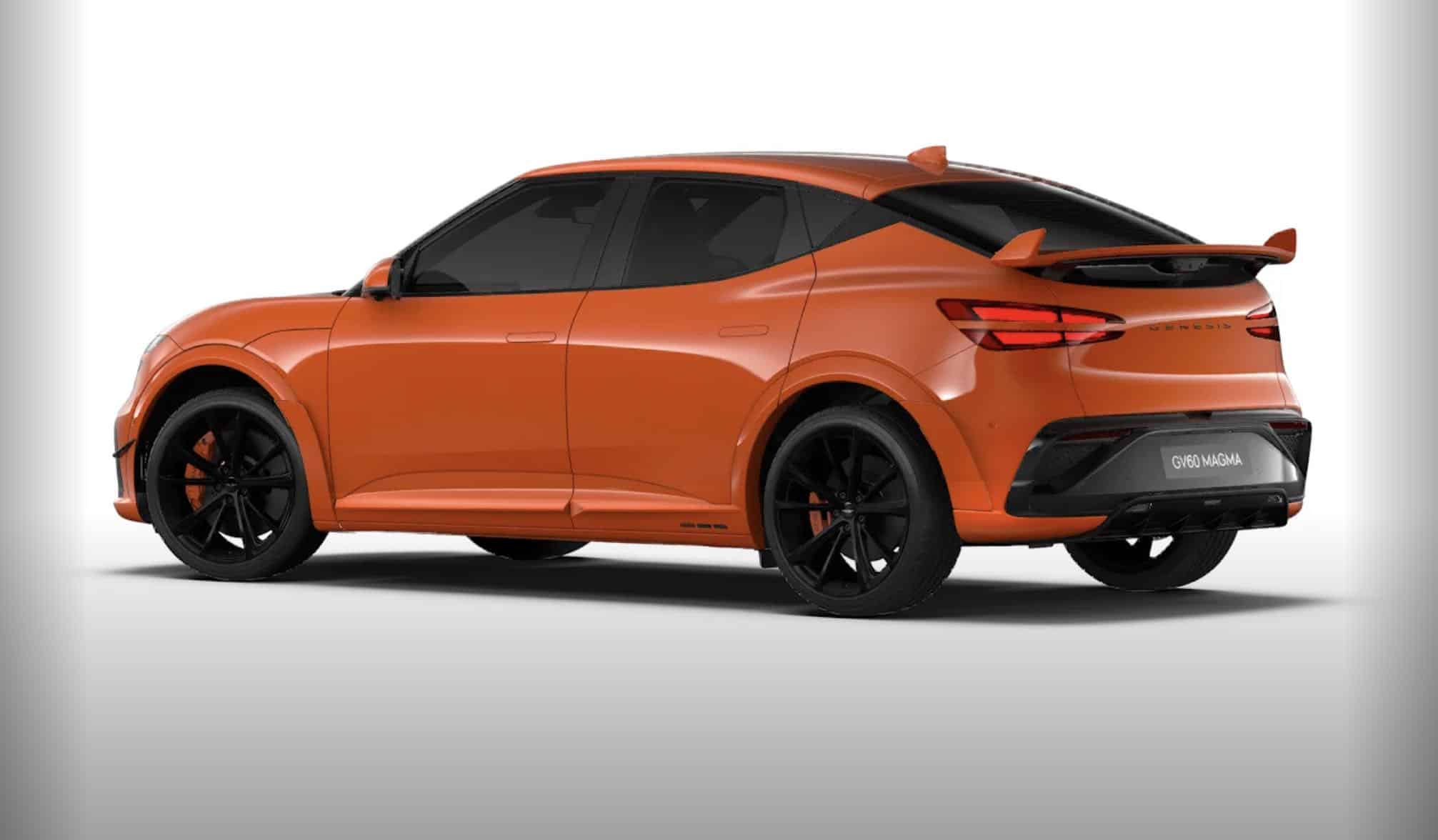
All-Electric Genesis GV60 Magma (credit: Genesis)
Pricing
Genesis Motor UK announced the Genesis GV60 Magma at £75,915 on the road on 28 May 2026, with one core performance specification. The manufacturer’s online information continues to use that figure, and an independent UK database quotes £75,100 as the recommended retail price before on-the-road items. The two figures have different accounting purposes and should not be presented as interchangeable or used to calculate a dealer discount.
The manufacturer offers nine exterior colours, with Alta White shown as the standard finish. Other choices include Magma Orange, Vik Black, Uyuni White, Saville Silver and several matte paints, while the dark interior is available with either Magma Orange or Ash White stitching. Current individual paint prices were not independently obtainable from the interactive UK configurator, so no invented option values appear in this guide. Request an itemised quotation for the precise combination.
A business contract hire illustration still visible on the model page was restricted to orders between 1 July and 30 September 2026 and should not be described as a current November offer. The 2026/27 UK zero-emission Benefit-in-Kind rate is 4%, but tax outcomes depend on the exact P11D value and personal circumstances. Insurance, performance tyres, servicing and potential depreciation deserve equal attention; our used-electric-car buying guide explains several factors relevant to eventual resale.
| UK price / choice | Genesis GV60 Magma | Position at 27 November 2026 |
|---|---|---|
| Manufacturer starting on-the-road price | £75,915 | UK manufacturer figure, options extra where applicable |
| RRP before OTR items | £75,100 | Independent UK database figure; not a verified final configurator quote |
| UK powertrain grade | Single Magma 84 kWh AWD grade | No separate UK standard-range or non-Boost Magma grade |
| Exterior finishes | Nine choices including standard Alta White | Other finish charges require current dealer confirmation |
| Interior stitching | Magma Orange or Ash White | Dark sport-seat interior; confirm selection availability |
| 2026/27 BiK percentage | 4% | Tax rate only; actual company-car tax depends on P11D and income tax |
| Historical business lease example | £879 + VAT per month advertised | Ordering eligibility expired 30 September 2026; NOT a current offer |
| Current delivery / final price | Confirm in writing | Configurator is interactive; live personalised figure not independently extracted |
Specifications
These four separate tables distinguish verified UK headline specifications, transparent charging-cost assumptions, physical practicality and normal-versus-Boost performance. There is only one established UK Magma grade; Boost is a temporary operating mode, not another model. Figures sourced solely from German manufacturer data or independent estimates are labelled accordingly. Where UK-specific towing, conventional boot or usable-battery certification is unavailable, the relevant value is qualified rather than invented.
| Battery, Emissions, Charging and Warranty | UK Genesis GV60 Magma 2026 / MY27 |
|---|---|
| EV classification | Battery-Electric Vehicle (BEV); dual-motor AWD |
| Advertised battery capacity | 84 kWh; separate UK usable-capacity figure not published in reviewed source |
| Estimated usable battery | Approximately 80 kWh from independent technical database; not OEM-certified UK figure |
| Battery chemistry | Lithium-ion; independent data identifies NMC, UK Magma document not conclusive |
| Combined WLTP electric range | Up to 264 miles |
| Combined electricity consumption | 2.9 mi/kWh from UK Genesis model page (WLTP) |
| AC charging | Type 2, up to 11 kW with suitable three-phase supply |
| DC interface | CCS rapid charging, 800-volt-class electrical architecture |
| Peak DC charging | Up to approximately 265 kW on UK site; 264 kW on German manufacturer page |
| DC charge time | 10–80% approximately 18 minutes on suitable 350 kW charger, favourable conditions |
| Battery preconditioning | Available; battery temperature and conditions affect charging and boost |
| Vehicle-to-Load (V2L) | Supported in international/independent equipment data; UK socket/adaptor verify |
| Tailpipe CO₂ emissions | 0 g/km |
| Euro NCAP safety | 2022 GV60 rating exists; 478 kW Magma not listed as independently assessed variant |
| Vehicle warranty, private use | 5 years, unlimited mileage, subject to conditions |
| High-voltage battery warranty | 8 years/100,000 miles; restoration to at least 70% original capacity under terms |
| Roadside assistance | 5 years under UK Genesis programme |
| Care Plan | Included under published OTR programme; own servicing/mileage conditions apply |
The next table is a calculation rather than a current electricity-tariff quotation. It treats the advertised 84 kWh as illustrative energy added, assumes 90% wall-to-battery efficiency and uses a hypothetical 25p/kWh household rate. The actual usable battery capacity, start and finish percentages, measured charging losses and standing charges will alter the bill. Rapid public charging is billed according to the operator’s tariff, which may be materially higher.
| Illustrative UK Home-Charging Cost | Assumption / method | Illustrative value |
|---|---|---|
| Advertised battery energy | Manufacturer headline figure | 84.00 kWh |
| Household electricity rate | Hypothetical; not a live tariff | £0.25/kWh |
| Wall-to-battery efficiency | Assumed 10% energy loss | 90% |
| Modelled 0–100% battery addition | Use 84 kWh solely as calculation input | 84.00 kWh |
| Modelled energy drawn from wall | 84 ÷ 0.90 | 93.33 kWh |
| Modelled full energy cost | (84 ÷ 0.90) × £0.25 | £23.33 |
| Modelled 10–80% battery addition | 84 × 70% | 58.80 kWh |
| Modelled 10–80% wall energy | 58.8 ÷ 0.90 | 65.33 kWh |
| Modelled 10–80% home cost | (58.8 ÷ 0.90) × £0.25 | £16.33 |
| Modelled 30–80% battery addition | 84 × 50%; not a DC tariff claim | 42.00 kWh |
| Dimensions and Practicality | Magma-specific figure / evidence qualification |
|---|---|
| Body / passenger capacity | Five-door crossover / SUV; five seats |
| Overall length | 4,635 mm (international Genesis data and independent UK database) |
| Overall width excluding mirrors | 1,940 mm (international Genesis data; UK certificate verify) |
| Width including mirrors | Not independently confirmed for UK Magma |
| Overall height | 1,560 mm (international Genesis data; UK certificate verify) |
| Wheelbase | 2,900 mm (international manufacturer data) |
| Stance | 20 mm lower than regular GV60; manufacturer claims wider track |
| Tyre and wheel specification | 21-inch forged wheels; wide Pirelli tyres |
| Rear cargo space | 670 litres to roof in German manufacturer data; not verified UK VDA belt-line volume |
| Front cargo / frunk | 20 litres from independent database; UK-specific figure to confirm |
| Rear-seat configuration | Five-seat cabin with split-folding rear bench |
| Child-seat points | Outboard rear ISOFIX indicated in platform-level specifications; UK vehicle confirm |
| Kerbweight | 2,315 kg EU unladen in independent database; UK figure not certified here |
| Braked / unbraked towing | UK Magma-specific approved limits not confirmed; seek CoC before towing |
| Roof carrying limits | Not independently verified; do not assume roof-rack approval |
| Powertrain and Performance by Variant / Mode | Single UK Magma — normal maximum | Same UK Magma — temporary Boost |
|---|---|---|
| UK derivative identity | 84 kWh Magma AWD | The SAME derivative, not another trim |
| Motor arrangement | Two electric motors, AWD | Same dual motors, AWD |
| Maximum combined output | 448 kW / 609 PS | 478 kW / 650 PS |
| Maximum combined torque | 740 Nm | 790 Nm |
| Boost duration | Not applicable | Up to 15 seconds, system conditions permitting |
| 0–62 mph | Separate normal-mode time not independently established | 3.4 seconds manufacturer claim |
| 0–124 mph | Not independently stated for normal operation | 10.9 seconds manufacturer figure under performance conditions |
| Maximum speed | Normal-mode value not separately stated | Up to 164 mph |
| Driving modes | Range, Comfort, GT and other selections | SPRINT and Boost focus on peak response |
| Transmission | Single-speed physical drive | Single-speed; Virtual Gear Shift is a simulation |
| Battery / WLTP | 84 kWh / up to 264 miles combined WLTP | Same battery; Boost does not create a separate WLTP rating |
| Peak DC charge / claimed time | Approximately 265 kW; 10–80% in about 18 min | Same charging hardware; thermal and usage conditions apply |
| Tyres / brakes | 21-inch forged wheels; 400 mm front discs | Same hardware; tuned for high performance |
| UK OTR starting price | £75,915 | No separate Boost surcharge or variant price |
The performance table separates two operating states of the same UK vehicle. It does not imply that Boost can remain active indefinitely, nor that the WLTP range was measured while repeatedly using maximum power. Independent estimates for usable battery energy and cargo capacity are identified as such, and UK towing approval remains unresolved. Confirm the VIN-linked specification and warranty conditions before relying on those details for a purchase or commercial use.
FAQs
| Question | Answer |
|---|---|
| What is the UK price of the Genesis GV60 Magma? | The manufacturer quotes £75,915 OTR for the single UK Magma grade. Extra-cost colours and final dealer quotations should be checked. |
| Does the GV60 Magma have two powertrain versions? | No. It has one UK 84 kWh dual-motor AWD specification. Normal maximum and temporary Boost figures refer to operating states of the same car. |
| How much power is available in Boost? | Up to 478 kW / 650 PS and 790 Nm for as long as approximately 15 seconds, subject to battery and operating conditions. |
| What is its official UK electric range? | Up to 264 miles combined WLTP. Real-world range can be considerably shorter with high-speed, cold-weather or performance driving. |
| How large is the battery? | Genesis advertises 84 kWh. An approximately 80 kWh usable estimate exists independently but was not separately confirmed in the UK manufacturer specification. |
| How fast does it charge? | Genesis quotes 10–80% DC in about 18 minutes on a suitable 350 kW charger, with a vehicle peak near 265 kW in optimal conditions. |
| Can I charge at home? | Yes. The onboard AC charging rate is up to 11 kW on suitable three-phase power, with lower limits common on UK single-phase wallboxes. |
| Can it tow? | A Magma-specific UK approved towing capacity was not established here; obtain vehicle certification before fitting a towbar or towing. |
| How big is the boot? | German Genesis data gives 670 litres measured to the roof, not a verified conventional UK VDA belt-line measurement. Check the vehicle for your luggage requirements. |
| Has the Magma been crash tested by Euro NCAP? | The 2022 five-star Genesis GV60 result does not explicitly cover the newer 478 kW Magma. No separate Magma-specific Euro NCAP assessment was established. |
| What is the warranty? | For qualifying private use, Genesis states five years of unlimited-mileage vehicle cover and eight years/100,000 miles for the high-voltage battery, including a 70% capacity provision under terms. |
| Is the £879 plus VAT business lease deal current? | No. The example shown on the manufacturer page was restricted to orders placed by 30 September 2026; request a current finance quotation. |
While e-zoomed uses reasonable efforts to provide accurate and up-to-date information, some of the information provided is gathered from third parties and has not been independently verified by e-zoomed. While the information from the third party sources is believed to be reliable, no warranty, express or implied, is made by e-zoomed regarding the accuracy, adequacy, completeness, legality, reliability or usefulness of any information. This disclaimer applies to both isolated and aggregate uses of this information.
Featured Articles
<!–
Carousel
–>

EcoFlow OCEAN 2 Plus Home Battery Storage: UK Price, Specifications, Solar & EV Charging Guide
The Genesis GV60 Magma is the first production model to wear Genesis’s new high-performance Magma identity. It takes the distinctive shape of the regular Genesis GV60 and adds substantially…
myenergi zappi GLO EV Charger: UK Price, Specifications & Solar Charging Guide
The Genesis GV60 Magma is the first production model to wear Genesis’s new high-performance Magma identity. It takes the distinctive shape of the regular Genesis GV60 and adds substantially…
All-Electric Škoda Peaq (2026): UK Prices, Specs, Range & Buying Guide
The Genesis GV60 Magma is the first production model to wear Genesis’s new high-performance Magma identity. It takes the distinctive shape of the regular Genesis GV60 and adds substantially…
Featured Products
-
<!–
–>Sale!
Best-In-Class Home Solar Bundle Offer (440W All Black Jinko Solar 8 Panels + Sungrow Hybrid Inverter 3.6 kW): price includes product supply only
<!– –>
Original price was: £2,205.95.£2,150.95Current price is: £2,150.95. (Including VAT)
<!–
–>
<!– Term:
NEDC range:
Model Year:
Deposit: £
Miles Per AnnumSubject to status and conditions –>
Brand:SungrowJinko SolarCategory:Solar<!– –>
-
<!–
–>Sale!
Best-In-Class Home Solar Bundle Offer (440W All Black Jinko Solar 8 Panels + Sungrow Battery Storage 6.4 kWh + Sungrow Hybrid Inverter 3.6 kW): price includes product supply only
<!– –>
Original price was: £5,010.95.£4,800.95Current price is: £4,800.95. (Including VAT)
<!–
–>
<!– Term:
NEDC range:
Model Year:
Deposit: £
Miles Per AnnumSubject to status and conditions –>
Brand:SungrowJinko SolarCategory:Solar<!– –>
-
<!–
–>Sale!
Bundle Offer: SUNSYNK LifePO4 Home Battery Storage (5.32 kWh) + SUNSYNK Hybrid Inverter (3.6 kW/Single-Phase): price includes product supply only
<!– –>
Original price was: £3,345.95.£3,299.95Current price is: £3,299.95. (Including VAT)
<!–
–>
<!– Term:
NEDC range:
Model Year:
Deposit: £
Miles Per AnnumSubject to status and conditions –>
Brand:Sun SynkCategory:Battery Storage<!– –>
-
Bundle Offer: Tesla Powerwall 3 Home Battery Storage (13.5 kWh) + Gateway: price includes product supply only
<!– –>
£8,559.95 (Including VAT)
<!–
–>
<!– Term:
NEDC range:
Model Year:
Deposit: £
Miles Per AnnumSubject to status and conditions –>
Brand:TeslaCategory:Battery Storage<!– –>
-
<!–
–>Sale!
Custom-Made Single-Phase EV Charging Cable Type 2 to Type 2 (2m to 50m, 7.4 kW, 32 amp, Black)
<!– –>
Price range: £99.95 through £670.95 (Including VAT)
<!–
–>
<!– Term:
NEDC range:
Model Year:
Deposit: £
Miles Per AnnumSubject to status and conditions –>
Category:CablesType:Type 2Length (m):5 m7.5 m10 m3.5 m12.5 m15 m20 m17.5 m2 m22.5 m25 m30 m35 m40 m45 m50 mCurrent (amp):32 ampPhase:Single Phase (7.2kW)<!– –>
This product has multiple variants. The options may be chosen on the product page -
Untethered Ohme ePod Home Smart EV Charger (7.4 kW): price includes product only
<!– –>
£645.95 (Including VAT)
<!–
–>
<!– Term:
NEDC range:
Model Year:
Deposit: £
Miles Per AnnumSubject to status and conditions –>
Brand:OhmeCategory:EV Charging PointsCustomer type:ResidentialPower:7.4 kWCable:UntetheredPhase:Single Phase<!– –>

The post All-Electric Genesis GV60 Magma (2026): UK Prices, Specs, Range & Buying Guide appeared first on Ezoomed.