
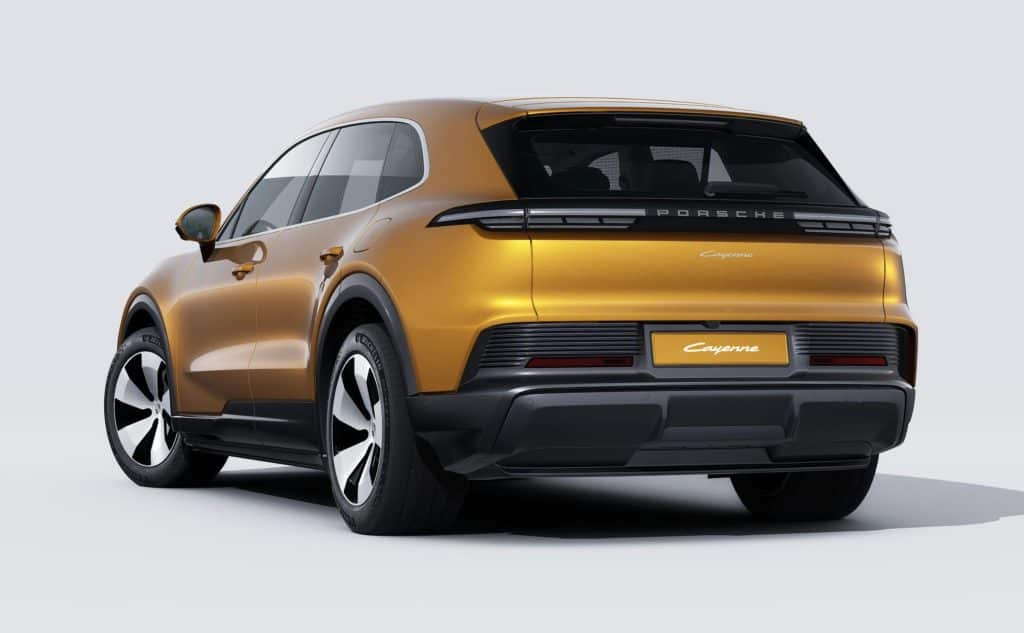
The Porsche Cayenne Electric brings battery-electric propulsion to Porsche’s large luxury SUV family without replacing the existing petrol and plug-in hybrid Cayenne models. For British buyers, the appeal lies in combining a spacious five-seat cabin, substantial towing ability and the brand’s performance focus with the quietness and instant response of electric motors. Its considerable size and premium price make it a different proposition from a compact electric crossover.
Porsche currently lists three UK model-year 2027 SUV derivatives: the Cayenne Electric, Cayenne S Electric and Cayenne Turbo Electric. Each uses a 113 kWh gross-capacity battery, electric all-wheel drive and an 800-volt charging architecture; the published combined WLTP range extends from 344 to 403 miles across the line-up. Prices start at £83,200 including VAT. The most powerful Turbo reaches 850 kW under Launch Control conditions.
The electric Cayenne was introduced internationally in late 2025, with the S version subsequently expanding the choice between the entry model and the Turbo. Porsche’s UK configurator now identifies the range as 2027 models. Accordingly, older launch figures should not be mixed indiscriminately with the current British specification. Availability, final equipment and delivery timing should be checked with an authorised Porsche Centre, particularly when selecting costly options or a specialist exterior finish.
Relevant UK alternatives include the BMW iX, Polestar 3, Volvo EX90 and Mercedes-Benz EQS SUV. They compete for premium SUV buyers but differ in size, seating arrangements, luxury priorities and price, so not every version is a direct pound-for-pound rival. The Cayenne’s combination of Porsche driving character, charging speed and potential 3.5-tonne towing capacity gives it a distinctive place in this market.
This guide examines UK list and on-the-road pricing, battery and charging performance, real-world ownership considerations, practicality, safety and equipment across all three SUV variants. It also explains why the headline charging and acceleration figures depend on specific conditions, and how optional equipment can change range and cost. This helps buyers choose a suitable specification rather than simply select the fastest model.
At a glance
| Feature | Porsche Cayenne Electric (2027) — UK summary |
|---|---|
| UK SUV line-up | Cayenne Electric / Cayenne S Electric / Cayenne Turbo Electric |
| Starting UK price | £83,200 incl. VAT; £83,265 base-model configurator OTR |
| EV type and body | Battery-Electric Vehicle (BEV); large five-seat SUV |
| Drive and battery | Dual-motor all-wheel drive; 113 kWh gross (approximately 108 kWh usable, independent estimate) |
| Combined WLTP range | 344–403 miles across the three SUV derivatives and equipment ranges |
| Performance | 4.8 / 3.8 / 2.5 seconds 0–62 mph with Launch Control (base / S / Turbo) |
| AC home charging | 11 kW on-board charger; 22 kW option; typical UK 7.4 kW domestic charging will be slower |
| DC rapid charging | Up to 390 kW for the specified 10–80% session; 16 min at suitable high-voltage charger |
| Boot and front storage | Rear 781 litres (base/S) or 747 litres (Turbo); 90-litre front compartment |
| Towing | 3,000 kg braked; up to 3,500 kg with applicable optional Offroad Package |
| Safety | Five-star Euro NCAP, 2025 assessment; validity sheet includes all three SUV derivatives |
| Tailpipe emissions | 0 g/km CO₂ |
All prices and range figures refer to current UK manufacturer listings for model year 2027; the WLTP range changes with derivative and specification. Porsche confirms 113 kWh gross capacity, while the approximately 108 kWh usable figure is independently estimated rather than separately specified on the current UK model pages. Charging times require suitable equipment and conditions, and the official range is not a prediction of motorway or winter mileage.
Table of Contents
Pros & cons
| PROS | CONS |
|---|---|
| 1. Strong touring potential: Up to 403 miles WLTP in the S version and an 800-volt system make this a credible long-distance luxury EV. | 1. High entry price: The £83,200 list price rises markedly with performance versions and Porsche options. |
| 2. Practical five-seat design: Generous rear storage, a 90-litre front compartment and substantial optional braked towing help justify the SUV footprint. | 2. Size and mass: Nearly five metres in length and more than 2.5 tonnes unladen make urban parking and tyre costs important considerations. |
| 3. Broad performance choice: All-wheel drive is standard, and even the base model reaches 62 mph in a claimed 4.8 seconds. | 3. Conditional headline claims: Maximum charging speed, acceleration and range depend on charger capability, battery condition, equipment and driving conditions. |
Sign up to the e-zoomed Electric Living newsletter
About Porsche: The company behind the Cayenne Electric
Porsche is a German performance-car manufacturer whose Cayenne first brought the marque into the luxury SUV market in 2002. Its modern battery-electric family began with the Porsche Taycan and expanded into electric SUVs, while combustion-engine and plug-in hybrid models continue alongside the new Cayenne Electric. This parallel approach means customers can compare different powertrains within the wider Cayenne family rather than assume every new Cayenne is fully electric.
The Cayenne Electric is produced in Bratislava, Slovakia, and shares key battery and electronic development priorities with Porsche’s wider electric-vehicle programme. Its dual-motor architecture and advanced thermal management pursue strong repeatable performance as well as short charging stops, but high-voltage capability does not remove the need for realistic journey planning. Buyers should also consider the long-term cost of specialist tyres, insurance, routine servicing and optional technology.
For background on the model name and its development, see the Porsche Cayenne history on Wikipedia. The historical account is distinct from the current UK electric model specifications and does not replace verified manufacturer data.
Meet the Porsche Cayenne Electric
Overview
The Porsche Cayenne Electric adopts a familiar Porsche SUV silhouette but sits on a dedicated electric architecture, with a broad stance and a long 3,023 mm wheelbase. Adaptive air suspension and Porsche Active Suspension Management are listed for the base version, bringing adjustable ride height and electronically controlled damping to a large, heavy vehicle. Its position is therefore closer to a refined grand-touring SUV than to a lightweight sports car, regardless of the acceleration available.
All three UK SUVs feature electric all-wheel drive and a five-seat interior, with the S adding a significant power increase and the Turbo prioritising ultimate performance. The model also offers height-adjustable suspension, modern driver-assistance systems and extensive personalisation choices, although not every advanced chassis feature is standard on every derivative. When comparing similarly priced cars, a careful build specification matters more than the headline trim name.
Battery & range
Every UK Cayenne Electric SUV variant uses a battery rated at 113 kWh gross, with a usable amount estimated by independent data providers at about 108 kWh. Porsche’s current British figures are 350–395 miles for the base model, 361–403 miles for the S and 344–384 miles for the Turbo on the combined WLTP cycle. These are equipment-dependent certification ranges, not promises that the least efficient specification will achieve the highest number.
The S has the best advertised upper-end WLTP range. By comparison, the more powerful Turbo sacrifices some certified efficiency for performance. Motorway speed, low temperatures, heavy loads, large wheels and towing can all reduce actual distance between charges; a comfortable buffer is sensible on long trips. Our guide to WLTP electric-car range explains why official and real-world figures can differ.
Charging
Porsche quotes an 11 kW AC on-board charger, with an optional 22 kW system and the possibility of optional wireless home charging with appropriate equipment. A full 0–100% charge is listed at around 11 hours on 11 kW AC, or 5.8 hours using the 22 kW option and a suitable supply. Most UK single-phase homes are limited to around 7.4 kW, so a domestic installation can take appreciably longer; charger ratings alone do not guarantee that much power at the vehicle.
The 800-volt system can reach up to 390 kW DC within Porsche’s specified fast-charging conditions, with a stated 16-minute 10–80% session on a suitably capable high-voltage charger. Porsche separately discusses brief peaks of up to 400 kW under a different, narrowly defined state-of-charge and battery-temperature window; that exceptional peak must not be confused with normal charging across the full session. On compatible 400-volt infrastructure Porsche quotes around 26 minutes from 10–80%, and actual results will vary.
A functioning high-power stop depends on charger voltage and current, battery pre-conditioning, arrival charge level and public-charger availability. Drivers should use the vehicle’s route planner and compare tariffs as well as charger power, especially because the fastest public units may be more expensive than overnight home electricity. The DC rapid-charging guide and charging-time explainer provide additional context for these practical differences.
Practicality
The Cayenne Electric measures 4,985 mm long in base and Turbo forms, while the S is quoted at 4,991 mm; all are 1,980 mm wide excluding mirrors and 2,199 mm including them. The rear luggage compartment holds 781 litres in the base and S versions, or 747 litres in the Turbo, with an additional 90-litre front compartment in all three. The figures are valuable for family luggage, although this remains a five-seat vehicle rather than a seven-seat alternative.
With the rear seats folded, Porsche lists 1,588 litres for the base and S models and 1,554 litres for the Turbo. Braked towing is rated at 3,000 kg, increasing to 3,500 kg only where the applicable Offroad Package and towing specification are fitted; towing can sharply reduce electric range. Drivers also need to allow for the vehicle’s width in older car parks and for its substantial weight when considering access, tyres and running costs.
Technology & equipment
The electric Cayenne combines a digital cockpit with an expansive central display, vehicle functions integrated into Porsche’s software environment and a mixture of touch and physical controls. Porsche’s UK standard-equipment information for the entry model includes Matrix LED headlights, eight-way electrically adjustable front comfort seats, heated steering wheel, adaptive air suspension and surround-view parking assistance. Option lists for audio, seating, paint, wheels and chassis systems are extensive, making it important to check an actual configuration rather than assume an illustrated car represents the base price.
Optional features include more elaborate chassis control, rear-axle steering, specialist comfort packages and a wireless charging arrangement that needs compatible hardware beyond the vehicle itself. The navigation-based charging planner can prepare the battery for a forthcoming rapid charge and optimise stops on a longer journey. Owners new to electric vehicles may find the beginner’s guide to EV charging useful when planning their home charging setup.
Performance
In standard maximum-output form, the base Cayenne Electric produces 300 kW, rising to 325 kW with Launch Control overboost; the S increases those figures to 400 and 490 kW. The Cayenne Turbo Electric is a major step beyond at 630 kW normally and up to 850 kW with Launch Control, with a maximum quoted torque of 1,500 Nm under those conditions. These overboost numbers should never be presented as continuous power available under every driving condition.
Porsche quotes 0–62 mph times of 4.8 seconds for the base SUV, 3.8 for the S and 2.5 for the Turbo, with respective top speeds of 143, 155 and 162 mph. Independent reviews suggest the combination of prompt throttle response, controlled body movements and strong refinement is central to the car’s character, although a full assessment requires driving the specific chosen chassis and wheel configuration. On UK roads, ride comfort, visibility and braking consistency can matter more than the final tenths of a sprint.
Safety
The Porsche Cayenne Electric received a five-star Euro NCAP assessment published in December 2025, with scores of 91% for adult occupants, 89% for children, 81% for vulnerable road users and 79% for safety assistance. The tested car was a left-hand-drive electric SUV, but the formal validity document includes right-hand-drive Cayenne Electric, Cayenne S Electric and Cayenne Turbo Electric derivatives. This is a 2025 assessment applicable to the specified range, not a separate 2027 retest.
The detailed testing records robust performance in many impact scenarios while also highlighting some limitations in individual protection and assistance categories. Porsche lists braking, parking and driver-support technologies on its UK model pages, but these remain assistance features rather than guarantees against collisions. Buyers should confirm exactly which active-safety functions and optional packs are fitted to their chosen vehicle and understand the systems’ operating limits.
The verdict
The Porsche Cayenne Electric brings genuine breadth to the premium electric SUV market by combining strong performance, long certified range and considerable passenger and luggage space. Its clear advantage over a performance-only electric car is that the same vehicle can manage family trips, motorway journeys and substantial towing duties when correctly equipped. The strongest overall case is the breadth of its capabilities, rather than any one acceleration headline.
The entry model already supplies ample performance for everyday UK driving, all-wheel drive, substantial equipment and a battery shared with the more expensive versions. The 16-minute optimal rapid-charge claim and long WLTP range are particularly attractive to regular long-distance drivers, provided the actual route offers suitable charging infrastructure. The practical cabin and front luggage area also contribute useful everyday versatility.
The principal reservations are its high purchase price, considerable size and dependence on optional equipment for some of the most appealing capabilities. Customers should not mistake the rare 400 kW charging peak for routine performance or assume that a 403-mile laboratory result applies to every version. Large wheels, cold weather and towing create further range and ownership-cost compromises that deserve attention before an order is placed.
For most buyers, the standard Cayenne Electric makes a persuasive starting point because its acceleration and equipment are already generous. The Cayenne S Electric is the logical next step for someone wanting stronger overtaking performance without reaching the Turbo’s price or consumption levels; it also has the highest quoted upper WLTP range. The Cayenne Turbo Electric is a specialist high-performance choice whose incremental value depends on whether its extraordinary output is genuinely useful.
The e-zoomed view: the Cayenne Electric deserves consideration from buyers who need the space and towing credentials of a large SUV but still want Porsche-style responses and very rapid charging potential. We would prioritise the right wheels, suspension, home-charging arrangements and usable equipment over chasing the maximum quoted acceleration figure. It is a compelling proposition, but not an inexpensive or especially compact way to drive electric.
Before ordering, obtain a current UK written quotation that distinguishes the VAT-inclusive list price from the OTR total and every selected option. Arrange a test drive on familiar roads, verify insurance and tyre costs, confirm whether home charging can supply the planned AC power and inspect the towing specification if relevant. Compare similarly equipped premium SUVs and use realistic winter and motorway energy estimates rather than planning every journey around the highest WLTP figure.
Gallery
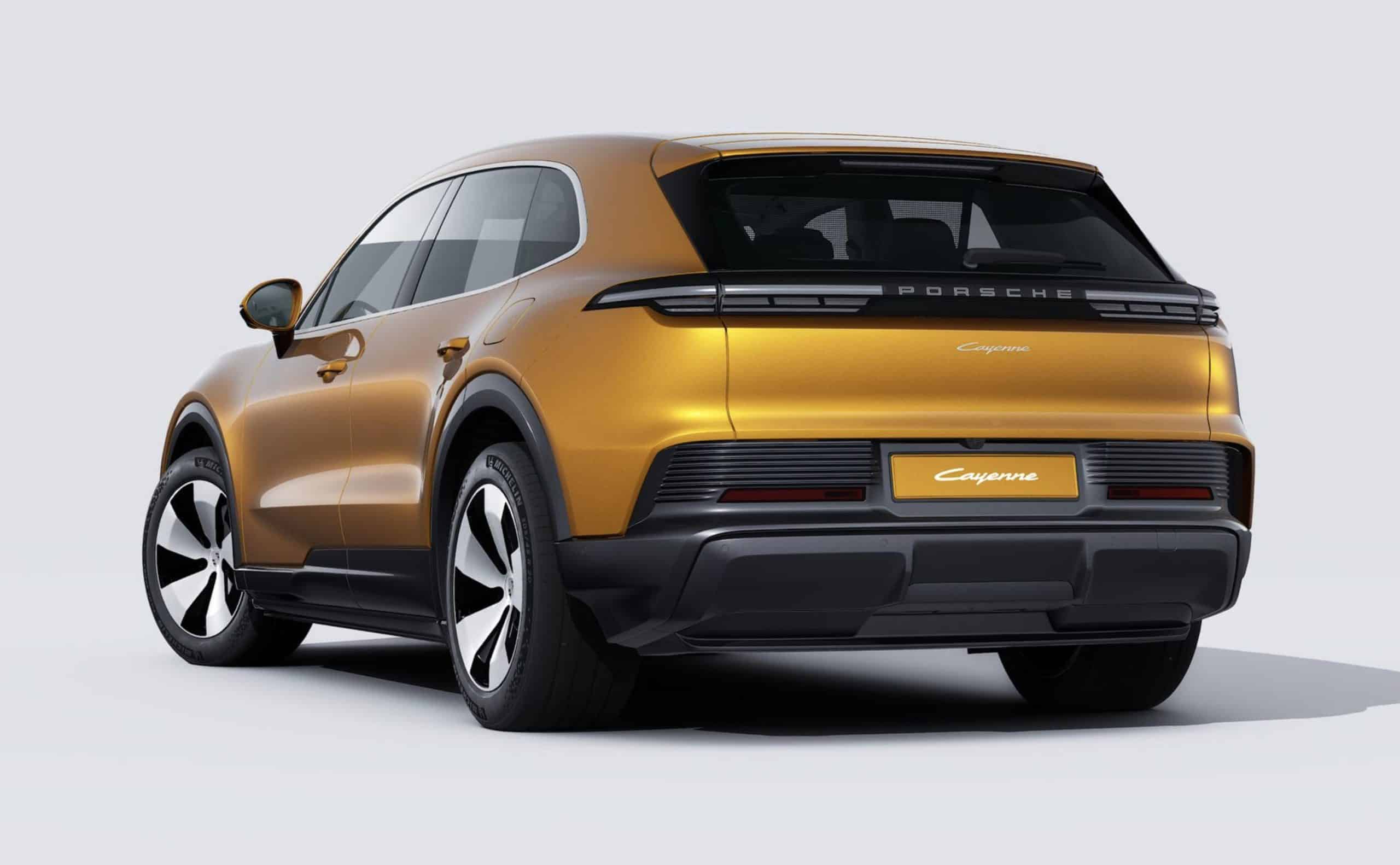
Porsche Cayenne Electric SUV (Credit: Porsche)
Pricing
Porsche’s current UK model-year 2027 listings start at £83,200 for the Cayenne Electric, £99,900 for the Cayenne S Electric and £130,900 for the Cayenne Turbo Electric, including VAT. Configurator starting totals add £65 in stated on-the-road charges to those listed prices, but the final amount will vary with options and any subsequent price changes. These three prices refer to the conventional five-seat SUV body, not the separate Coupé Electric range.
| UK MY2027 SUV derivative | Starting UK price incl. VAT | Starting UK OTR (configurator) |
|---|---|---|
| Cayenne Electric | £83,200 | £83,265 |
| Cayenne S Electric | £99,900 | £99,965 |
| Cayenne Turbo Electric | £130,900 | £130,965 |
The table reflects Porsche’s UK listings and base configurations checked on 20 November 2026, rather than discounted dealer offers or an indication of finance eligibility. OTR amounts incorporate the configurator’s stated first-registration fee and first-year VED; changes to taxation or options can alter the result. Compare insurance, servicing, charging costs and any residual-value assumptions before relying on a monthly payment as the complete cost of ownership.
Specifications
The following grouped specifications relate to the UK 2027 SUV family rather than the separate Cayenne Coupé Electric. Porsche’s current UK pages take precedence over early international launch material where ranges or charging labels differ, and any independently estimated capacity is identified as such. Equipment-dependent measurements and exceptional charging conditions are qualified to avoid combining incompatible variants or model years.
| Battery, Emissions, Charging and Warranty | UK MY2027 specification |
|---|---|
| Traction battery (all three) | 113.0 kWh gross; lithium-ion, 800-volt architecture |
| Estimated usable capacity | Approximately 108 kWh; independent estimate, not separately certified on Porsche UK model pages |
| Combined WLTP range — base | 350–395 miles |
| Combined WLTP range — S | 361–403 miles |
| Combined WLTP range — Turbo | 344–384 miles |
| Combined electricity use | Base 2.8–3.1; S 2.9–3.2; Turbo 2.8–3.0 mi/kWh, equipment-dependent |
| AC on-board charging | 11 kW standard; 22 kW optional (suitable supply required) |
| Quoted full AC charge (0–100%) | 11 h at 11 kW; 5.8 h at 22 kW; slower on typical 7.4 kW UK home supply |
| DC charging power | Up to 390 kW within specified 10–80% conditions; up to 400 kW only in a separate exceptional short-duration window |
| DC 10–80% at suitable high-voltage charger | 16 min under optimal battery/charger conditions |
| DC 10–80% on compatible 400 V infrastructure | 26 min under specified conditions |
| UK new vehicle warranty | 3 years against manufacturing defects, subject to terms |
| High-voltage battery warranty | 8 years / 100,000 miles; capacity thresholds 80% up to 3 years/38,000 miles, then 70% until warranty end, subject to terms |
| Euro NCAP | Five stars (December 2025): all three SUV derivatives included in published validity scope |
| Tailpipe CO₂ | 0 g/km |
Public DC performance is not equivalent to a domestic charger rating: Porsche specifies demanding voltage, current and battery temperature conditions for its highest charging outputs. Always allow for charging losses, public prices and reduced charging speed outside the ideal state-of-charge window. Battery warranty protection also contains usage, service and eligibility conditions that should be checked against the current UK warranty terms.
| Illustrative UK Home-Charging Cost | Calculation and assumptions |
|---|---|
| Example energy added to battery | 100 kWh — illustrative partial/replenishment scenario, not a full-battery capacity claim |
| Illustrative charging efficiency | 90%; input from meter = 100 ÷ 0.90 = 111.11 kWh |
| Example standard electricity unit rate | 25p/kWh (illustrative tariff assumption, not a quoted current supplier tariff) |
| Illustrative cost at 25p/kWh | 111.11 × £0.25 = £27.78 |
| Example overnight electricity unit rate | 7p/kWh (illustrative specialist tariff assumption, subject to eligibility) |
| Illustrative cost at 7p/kWh | 111.11 × £0.07 = £7.78 |
| Excluded costs | Standing charges, charger installation, variable tariffs, preconditioning and other household use |
The examples calculate the cost of adding 100 kWh to the battery after assumed AC charging losses, not a promise of a full 0–100% charge or a quoted Porsche electricity bill. Actual usable energy, tariff, ambient conditions and charging efficiency can change the cost materially. Buyers should compare their own household tariff and installation constraints, particularly if contemplating a 22 kW AC option.
| Dimensions and Practicality | UK MY2027 SUV specification |
|---|---|
| Length | 4,985 mm (base/Turbo); 4,991 mm (S) |
| Width without / with mirrors | 1,980 / 2,199 mm |
| Height at standard air-suspension level | 1,674 mm across listed variants |
| Wheelbase | 3,023 mm |
| Seating | Five occupants, two front and three rear |
| Rear luggage volume, seats up | 781 litres (base/S); 747 litres (Turbo) |
| Rear luggage volume, seats folded | 1,588 litres (base/S); 1,554 litres (Turbo) |
| Front luggage compartment | 90 litres |
| Braked towing capacity | 3,000 kg; 3,500 kg only with the applicable Offroad Package/tow specification |
| Unbraked towing / roof load | 750 kg / 100 kg (applicable equipment limits) |
| Unladen DIN mass | 2,525 kg base; 2,555 kg S; 2,645 kg Turbo |
| Turning circle | 12.7 m; 11.6 m with rear-axle steering |
The dimensions and luggage figures above come from the current Porsche UK derivative pages and are not interchangeable with Coupé Electric versions. Optional tow equipment and an appropriate licence and load configuration may be needed to use the maximum braked rating. Check the specific UK order’s vehicle plate, tyres and payload before carrying heavy passengers or luggage while towing.
| Powertrain and Performance by Variant | Drive | Normal max power | Launch Control overboost | Maximum torque with Launch Control | 0–62 mph | Top speed |
|---|---|---|---|---|---|---|
| Cayenne Electric | AWD | 300 kW / 408 PS | 325 kW / 442 PS | 835 Nm | 4.8 s | 143 mph |
| Cayenne S Electric | AWD | 400 kW / 544 PS | 490 kW / 666 PS | 1,080 Nm | 3.8 s | 155 mph |
| Cayenne Turbo Electric | AWD | 630 kW / 857 PS | 850 kW / 1,156 PS | 1,500 Nm | 2.5 s | 162 mph |
Launch Control and overboost refer to manufacturer-defined peak operating conditions; they do not describe power sustained indefinitely in normal driving. Figures are for the specified UK model-year 2027 SUV derivatives, and quoted top speeds and acceleration are manufacturer claims rather than measurements from an e-zoomed road test. See our guide to types of electric vehicles for the distinction between pure EVs and the wider Cayenne family’s plug-in hybrid models.
FAQs
| Question | Answer |
|---|---|
| Is the Porsche Cayenne Electric sold in the UK? | Yes. Porsche lists UK model-year 2027 SUV configurations for the base, S and Turbo Electric, subject to dealer availability and delivery dates. |
| How much is the Porsche Cayenne Electric? | The base UK list price starts at £83,200 incl. VAT; its base configurator displays £83,265 OTR before options. |
| What is the longest WLTP range? | Up to 403 miles for the Cayenne S Electric in eligible configurations; actual range will differ. |
| What is the battery capacity? | All three have 113 kWh gross; approximately 108 kWh usable is independently estimated rather than confirmed on Porsche’s current UK specification page. |
| Are all three models all-wheel drive? | Yes. Each UK SUV derivative uses motors at both axles for electric AWD. |
| How long is a rapid charge? | Porsche quotes 16 minutes from 10–80% on a suitable high-voltage DC charger under optimal conditions. |
| Does the Cayenne really charge at 400 kW? | Porsche describes up to 390 kW in defined 10–80% charging conditions and a separate exceptional peak of 400 kW under narrower conditions. |
| Can I use a standard UK home charger? | Yes, with a compatible installation, but a typical 7.4 kW supply charges more slowly than the manufacturer’s 11 kW or optional 22 kW examples. |
| Is 22 kW AC charging standard? | No. The UK standard on-board AC charger is 11 kW; higher-power AC hardware is optional. |
| How large is the boot? | The base and S models have 781 litres behind the rear seats; Turbo has 747 litres, plus a 90-litre front compartment. |
| Can the electric Cayenne tow a trailer? | Porsche lists 3,000 kg braked capacity and up to 3,500 kg with the relevant optional Offroad Package and towing configuration. |
| Does the Cayenne Electric have a five-star safety rating? | Yes. Euro NCAP published a five-star result in 2025 with formal validity covering base, S and Turbo electric SUVs in both drive orientations. |
| What battery warranty applies? | Porsche lists eight years or 100,000 miles for the high-voltage battery, with conditions and specified residual-capacity thresholds. |
| Is the Cayenne Coupé Electric included here? | No. This guide covers the three conventional five-seat SUV models; Coupé Electric derivatives have distinct prices and some different dimensions and WLTP ranges. |
While e-zoomed uses reasonable efforts to provide accurate and up-to-date information, some of the information provided is gathered from third parties and has not been independently verified by e-zoomed. While the information from the third party sources is believed to be reliable, no warranty, express or implied, is made by e-zoomed regarding the accuracy, adequacy, completeness, legality, reliability or usefulness of any information. This disclaimer applies to both isolated and aggregate uses of this information.
Featured Articles
<!–
Carousel
–>
myenergi zappi GLO EV Charger: UK Price, Specifications & Solar Charging Guide
The Porsche Cayenne Electric brings battery-electric propulsion to Porsche’s large luxury SUV family without replacing the existing petrol and plug-in hybrid Cayenne models. For British buyers, the appeal lies…
Fox ESS EQ5000 Home Battery Storage: UK Price, Specifications, Solar & EV Charging Guide
The Porsche Cayenne Electric brings battery-electric propulsion to Porsche’s large luxury SUV family without replacing the existing petrol and plug-in hybrid Cayenne models. For British buyers, the appeal lies…
All-Electric Mercedes-Benz GLB (2026): UK Prices, Specs, Range & Buying Guide
The Porsche Cayenne Electric brings battery-electric propulsion to Porsche’s large luxury SUV family without replacing the existing petrol and plug-in hybrid Cayenne models. For British buyers, the appeal lies…
Featured Products
-
<!–
–>Sale!
Best-In-Class Home Solar Bundle Offer (440W All Black Jinko Solar 8 Panels + Sungrow Hybrid Inverter 3.6 kW): price includes product supply only
<!– –>
Original price was: £2,205.95.£2,150.95Current price is: £2,150.95. (Including VAT)
<!–
–>
<!– Term:
NEDC range:
Model Year:
Deposit: £
Miles Per AnnumSubject to status and conditions –>
Brand:SungrowJinko SolarCategory:Solar<!– –>
-
<!–
–>Sale!
Best-In-Class Home Solar Bundle Offer (440W All Black Jinko Solar 8 Panels + Sungrow Battery Storage 6.4 kWh + Sungrow Hybrid Inverter 3.6 kW): price includes product supply only
<!– –>
Original price was: £5,010.95.£4,800.95Current price is: £4,800.95. (Including VAT)
<!–
–>
<!– Term:
NEDC range:
Model Year:
Deposit: £
Miles Per AnnumSubject to status and conditions –>
Brand:SungrowJinko SolarCategory:Solar<!– –>
-
<!–
–>Sale!
Bundle Offer: SUNSYNK LifePO4 Home Battery Storage (5.32 kWh) + SUNSYNK Hybrid Inverter (3.6 kW/Single-Phase): price includes product supply only
<!– –>
Original price was: £3,345.95.£3,299.95Current price is: £3,299.95. (Including VAT)
<!–
–>
<!– Term:
NEDC range:
Model Year:
Deposit: £
Miles Per AnnumSubject to status and conditions –>
Brand:Sun SynkCategory:Battery Storage<!– –>
-
Bundle Offer: Tesla Powerwall 3 Home Battery Storage (13.5 kWh) + Gateway: price includes product supply only
<!– –>
£8,559.95 (Including VAT)
<!–
–>
<!– Term:
NEDC range:
Model Year:
Deposit: £
Miles Per AnnumSubject to status and conditions –>
Brand:TeslaCategory:Battery Storage<!– –>
-
<!–
–>Sale!
Custom-Made Single-Phase EV Charging Cable Type 2 to Type 2 (2m to 50m, 7.4 kW, 32 amp, Black)
<!– –>
Price range: £99.95 through £670.95 (Including VAT)
<!–
–>
<!– Term:
NEDC range:
Model Year:
Deposit: £
Miles Per AnnumSubject to status and conditions –>
Category:CablesType:Type 2Length (m):5 m7.5 m10 m3.5 m12.5 m15 m20 m17.5 m2 m22.5 m25 m30 m35 m40 m45 m50 mCurrent (amp):32 ampPhase:Single Phase (7.2kW)<!– –>
This product has multiple variants. The options may be chosen on the product page -
Untethered Ohme ePod Home Smart EV Charger (7.4 kW): price includes product only
<!– –>
£645.95 (Including VAT)
<!–
–>
<!– Term:
NEDC range:
Model Year:
Deposit: £
Miles Per AnnumSubject to status and conditions –>
Brand:OhmeCategory:EV Charging PointsCustomer type:ResidentialPower:7.4 kWCable:UntetheredPhase:Single Phase<!– –>

The post Porsche Cayenne Electric (2027): UK Prices, Specs, Range & Buying Guide appeared first on Ezoomed.