
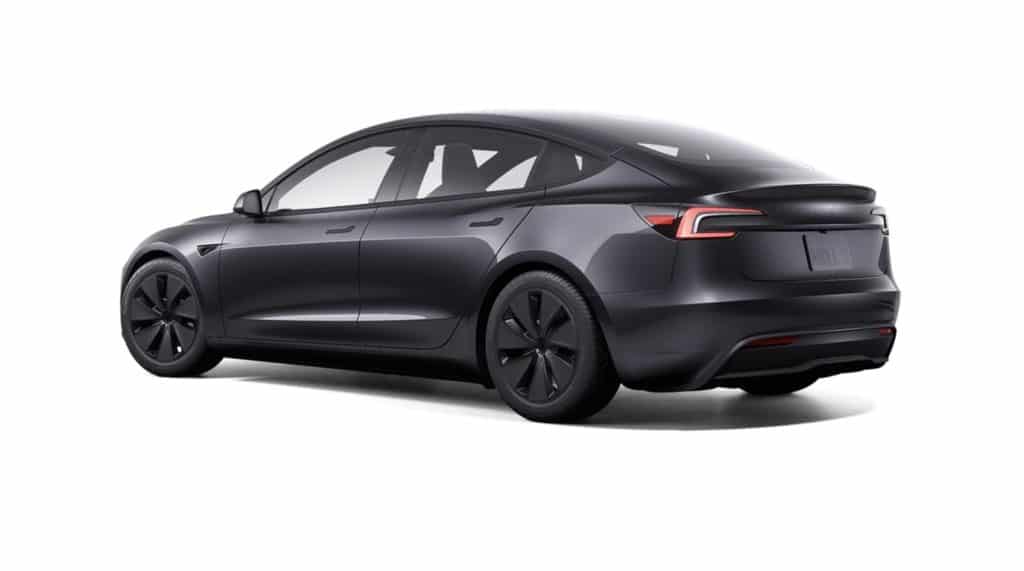
The Tesla Model 3 is an electric five-seat saloon that prioritises efficiency, straightforward long-distance charging and a minimalist cabin. Its relatively low body gives it a different character from a family SUV, while the boot and front storage compartment make it more usable than its sleek roofline suggests. For UK buyers, the current range stretches from a more affordable rear-wheel-drive car to two longer-range Premium versions and a much quicker Performance model.
For the 2026 UK line-up, the Model 3 Rear-Wheel Drive starts at £37,990, followed by the Model 3 Premium Long Range RWD at £44,990, the Model 3 Premium Long Range AWD at £49,990 and the Model 3 Performance at £59,990. The advertised combined WLTP figures run from 332 to 466 miles across the four configurations. These are November 2026 cash-price starting points, and individual wheels, options and short-term incentives can change the order total.
The revised Model 3 body arrived in the UK before the latest entry-level version was introduced in 2026, so the newest car should not be confused with a 2019 or 2021 example. Tesla sells through its online configurator and may adjust equipment or software during a model run rather than waiting for a conventional annual facelift. We therefore distinguish manufacturer-confirmed specifications from estimates of battery capacity and independently interpreted performance figures.
Natural UK rivals include the Hyundai IONIQ 6, BYD SEAL, Polestar 2 and BMW i4. They differ in body design, cockpit controls, suspension feel and charging characteristics, and their equivalent trims are not always similarly priced. The Model 3 stands out for its charging-route integration and long-distance efficiency, although its dependence on a central touchscreen will not suit everyone.
This buying guide covers every mainstream UK 2026 derivative, the difference between certified WLTP range and expected motorway mileage, charging at home and in public, running costs, safety, equipment and everyday practicality. It also compares Tesla’s published 0–60 mph numbers with independently reported 0–62 mph figures, and explains where a towbar or optional features have version-specific restrictions. The aim is to make the final ordering decision more precise, without mixing older Model 3 specifications into the current range.
At a glance
| Feature | Tesla Model 3 (2026) — UK overview |
|---|---|
| UK derivatives | Model 3 RWD; Model 3 Premium Long Range RWD; Model 3 Premium Long Range AWD; Model 3 Performance |
| Starting UK price | From £37,990 cash/OTR for the entry RWD; dated November 2026 check |
| Body style and seats | Four-door, five-seat electric saloon |
| Battery | Tesla UK does not consistently publish gross/usable capacity; approximately 58–79 kWh usable from independent estimates |
| Combined WLTP range | 332 / 466 / 410 / 354 miles respectively, depending on derivative and wheel configuration |
| Drivetrain | Single-motor RWD on entry/Premium RWD; dual-motor AWD on Premium AWD/Performance |
| 0–60 mph (Tesla) | 6.2 / 4.9 / 3.8 / 2.9 seconds respectively; Performance with rollout subtracted |
| DC rapid charging | Up to 175 kW entry RWD; up to 250 kW on Premium/Performance, conditional |
| AC charging | Up to 11 kW with suitable three-phase AC; about 7.4 kW on suitable UK single-phase home installation |
| Luggage | 594-litre rear boot + 88-litre front compartment = 682 litres combined, five seats in use |
| Braked towing | Up to 1,000 kg with approved tow equipment on eligible non-Performance models; up to 500 kg for Performance |
| Safety | Five-star Euro NCAP (May 2025): 90% adult, 93% child, 89% vulnerable road users, 87% safety assist |
| UK warranty | 4 years/60,000 miles vehicle; 8 years/100,000 or 120,000 miles battery/drive, depending on derivative |
| Tailpipe emissions | 0 g/km CO₂ |
The model figures above are taken from current UK manufacturer and independent sources checked on 21 November 2026, with prices cross-referenced to a dated 1 November configurator record. The battery-capacity figures are estimates, not Tesla-certified capacities. WLTP numbers use a laboratory cycle, the fastest public-charge claim depends on battery temperature and charger availability, and the Performance towing limit is lower than the maximum for the other eligible models.
Table of Contents
Pros & cons
| PROS | CONS |
|---|---|
| 1. Excellent long-distance potential: The Premium Long Range RWD combines an advertised 466-mile WLTP range with efficient saloon packaging. | 1. Control layout needs adaptation: Many everyday functions depend on the central touchscreen rather than familiar buttons. |
| 2. Easy charging ecosystem: Integrated Tesla Supercharger planning and battery preconditioning simplify cross-country travel. | 2. Battery data is not fully transparent: The manufacturer does not supply a consistent gross/usable kWh table for the current UK line-up. |
| 3. Useful performance choices: The entry RWD is adequate for most drivers, while the AWD and Performance versions offer much faster acceleration. | 3. Practical compromises: Saloon boot access, version-specific towing limits, potentially high insurance and firm large-wheel ride need consideration. |
Sign up to the e-zoomed Electric Living newsletter
About Tesla: The company behind the Model 3
Tesla developed from a specialist electric-car manufacturer into a global producer of vehicles, batteries and charging infrastructure. The Tesla Model 3 brought the brand’s electric saloon to a much wider audience, while the related Tesla Model Y adds a taller SUV body for buyers needing different passenger and luggage access. This close relationship explains shared software and charging ideas without making their dimensions, batteries or prices interchangeable.
The current Model 3 traces its cabin and body updates to the revised design introduced in 2023–24, with a simplified entry version added in 2026 and later equipment and performance changes. Tesla can alter specifications through production updates and its digital sales process, so a model-year label does not guarantee identical hardware on every delivered vehicle. Buyers researching an earlier generation should consult the historical Tesla Model 3 UK review rather than apply older battery and pricing data to a new order.
For background on the car’s development, the Tesla Model 3 history on Wikipedia provides an overview. Its historical information is not the basis for today’s UK derivative specifications.
Meet the Tesla Model 3
All four UK versions are five-seat electric saloons, but their powertrains, equipment and wheel choices affect the ownership experience. The following review considers the model in everyday British conditions, while identifying where the available information is manufacturer-reported rather than the result of an independent e-zoomed road test.
Overview
The refreshed Model 3 has a low roofline, flush exterior treatment, slim lighting and a prominent glass roof. It feels more like a conventional executive saloon in driving position than the higher-riding Model Y, yet retains a sizeable rear boot and an 88-litre front compartment. The battery is mounted low in the floor, contributing to its planted character without eliminating the weight associated with a long-range electric drivetrain.
Inside, the central display carries most driving information and settings, while the Tesla app supports access, preconditioning and charge monitoring. Premium versions offer a richer comfort and audio specification than the simplified RWD, and the Performance brings more focused seating and chassis hardware. A test drive of the exact trim is useful because the wheel choice and tyre profile can influence road noise and ride quality more than many buyers expect.
Battery & range
Tesla lists a combined WLTP range of 332 miles for the Model 3 RWD, 466 miles for the Model 3 Premium Long Range RWD, 410 miles for the Model 3 Premium Long Range AWD and 354 miles for the Model 3 Performance. These quoted figures apply to particular configurations and should be checked against the exact wheels in the UK order. The Premium Long Range RWD is the clear range leader in this four-version family.
Tesla does not publish a consistently comparable UK gross/usable battery table. Independent specifications place the newer entry RWD at roughly 58–60 kWh usable and the Premium/Performance cars at about 79 kWh usable, while other estimators quote different nominal or gross values. These are not precise manufacturer-certified capacities, and they should not be mixed with an earlier production battery. For a purchaser, the certified range and actual charging performance are more useful than an unverified kWh headline.
Cold weather, motorway speeds, steep climbs and sustained heating use can reduce the distance achieved on a full charge. The 466-mile WLTP claim is an especially attractive comparative benchmark, but it does not mean every driver will travel that distance at a continuous 70 mph in winter. Our WLTP range guide explains the laboratory test and why realistic journey allowances remain sensible.
Charging
Tesla quotes up to 175 kW DC for the entry Model 3 RWD, increasing to as much as 250 kW for the Premium and Performance versions on appropriately capable chargers. Those are peak capabilities, not a sustained power level across an entire 10–80% charge. Navigation can prepare the battery before a Supercharger arrival, but actual charging depends on state of charge, temperature, stall availability and the power delivered by the station.
The route planner integrates charging stops and can help manage longer UK journeys, including charging to a sufficient level for the next leg. Our Tesla Supercharger guide covers the network, and the DC rapid-charging guide explains why two cars at the same high-power station may take different times to charge. Drivers should check the live price per kWh, access conditions and potential queues rather than rely on speed alone.
A compatible home installation generally offers up to around 7.4 kW on a UK single-phase supply; Tesla’s on-board AC system can accept up to 11 kW where a suitable three-phase connection is available. A higher-capacity battery typically takes longer to replenish from the same low state of charge, although a full refill is seldom needed every night. Our home-charging time guide provides the underlying calculation and typical installation considerations.
Practicality
Tesla’s current European owner information gives a length of 4,720 mm for RWD and long-range models, rising marginally to 4,724 mm for Performance. Overall width is 1,850 mm without mirrors and 2,089 mm with them extended; the wheelbase is 2,875 mm. The Performance sits slightly lower at approximately 1,431 mm high, versus around 1,440 mm for the other versions. These dimensions help with parking decisions but should be checked against the vehicle ordered.
The manufacturer lists a rear boot of 594 litres, plus an 88-litre front compartment, giving 682 litres of enclosed storage with the rear seats in use. That combined total is not a single rear opening, and large boxes can be harder to load through a saloon boot than through a tall hatchback. The rear seatbacks fold to accommodate longer items, although the available official measurements should not be replaced with an invented maximum folded-seat volume.
An approved Tesla tow package is available for compatible vehicles, but its official UK specification makes an important distinction: eligible RWD and AWD versions can tow up to 1,000 kg, while Model 3 Performance is limited to 500 kg with the compatible accessory. Trailer weight, tyre requirements, towball loading and the individual vehicle plate take precedence over a general range claim. Even a light trailer can significantly reduce real-world electric range.
Technology & equipment
The cabin uses an uncluttered dashboard, central touchscreen, smartphone key capability and software updates rather than many physical controls. Premium versions add comfort, infotainment and audio upgrades, with exact specifications depending on the build, while the simplified RWD removes selected conveniences to meet its lower price. Buyers should inspect seat materials, sound systems and rear-passenger amenities on the actual chosen car instead of relying on promotional images of a higher trim.
Navigation and charge scheduling are central strengths, especially when a planned route includes stops that support battery preconditioning. Tesla also offers driver-assistance functions, but they are not a substitute for driver attention or responsibility. Any additional automated-driving features must be judged against current UK legal availability, the particular vehicle’s hardware and software, and the conditions of the package purchased; marketing terminology alone does not establish autonomous operation.
Software-centred ownership can be convenient, yet it places more emphasis on comfort with touch controls, notifications and the mobile app. The lack of conventional dashboard instruments and the operation of some vehicle functions take adjustment, particularly for drivers coming from traditional saloons. A careful handover, sensible notification settings and familiarity with emergency manual controls matter more than the number of digital features advertised.
Performance
Tesla’s UK figures for 0–60 mph are 6.2 seconds for the Model 3 RWD, 4.9 seconds for the Premium Long Range RWD, 3.8 seconds for the Premium Long Range AWD and 2.9 seconds for the Model 3 Performance. The Performance time is specified with rollout subtracted and is not directly comparable with every independent standing-start test. Each variant is brisk for its intended role, although most drivers will notice ride comfort, visibility and smooth power delivery more often than maximum acceleration.
Tesla does not consistently publish a UK by-trim motor-power and torque table, so the numerical comparison below distinguishes manufacturer acceleration claims from independently estimated 0–62 mph and output figures. The Performance has adaptive damping and more focused handling equipment, accompanied by different wheels and potentially higher replacement-tyre costs. An independent drive in the chosen configuration is preferable to treating the strongest version as automatically the best everyday purchase.
Safety
The refreshed Tesla Model 3 received five stars in Euro NCAP testing published on 21 May 2025, with 90% adult occupant, 93% child occupant, 89% vulnerable road-user and 87% safety-assistance scores. Euro NCAP’s current model-validity information includes electric rear-wheel-drive, Premium long-range and Performance variants, for both left- and right-hand-drive vehicles. This is a 2025 result applicable to the listed model range, not a fresh crash test conducted during 2026.
The assessment identifies strengths in many crash and automated emergency-braking scenarios, while its individual categories still have limitations that the five-star headline cannot convey. Tesla’s active safety features, lane support and driver monitoring are assistance technologies, not guarantees of accident prevention. Prospective owners should familiarise themselves with the current UK warnings and operating conditions and never depend on a marketing description in place of attentive driving.
The verdict
The current Tesla Model 3 offers a strong combination of long-distance efficiency, electric performance and competitive UK pricing in a comparatively compact saloon. Its charging ecosystem and route planning simplify travel for drivers who occasionally need to cross the country, while the low body suits those who prefer a car-like seating position. It is not, however, a traditional dashboard-and-buttons proposition, and that difference deserves a proper test drive.
The entry Model 3 RWD is a sensible starting point for buyers prioritising price and everyday commuting. Its 332-mile WLTP rating and useful storage are more than sufficient for many households with dependable overnight charging. The additional cost of Premium specification should be judged against how often the owner will use the longer range, cabin enhancements and faster headline DC capability.
For regular motorway journeys, the Model 3 Premium Long Range RWD makes a particularly persuasive case because it combines the highest quoted 466-mile WLTP figure with a price below the AWD models. The Premium Long Range AWD adds traction and quicker responses, though its 410-mile certified range is lower. Neither result is guaranteed in winter conditions or with larger wheels, so buyers should plan around actual routes rather than assuming the WLTP number is a daily target.
The Model 3 Performance is the enthusiast option: acceleration is extraordinary for the money and its chassis specification is more purposeful. The trade-offs are a higher initial price, potentially firmer ride, more expensive tyres and a lower towing limit than the other eligible cars. Buyers who will rarely use the additional capability may be better served by Premium long-range specification.
The main objections are the screen-focused control system, the limitations of a conventional saloon boot opening and the lack of a manufacturer-published, trim-by-trim usable battery-capacity chart. Insurance and public charging costs also require realistic budgeting. Tesla’s UK configurations change over time, so quoted prices, installed equipment, battery details and delivery timing should all be checked in a written final order.
The e-zoomed view: Compare the entry RWD and Premium Long Range RWD first, then decide whether the extra traction and performance of AWD justify their price. We would prioritise convenient home charging, the right wheel specification, affordable insurance and a comfortable test drive over an acceleration headline. The Model 3 is especially compelling for someone wanting an efficient electric saloon rather than the higher load opening of an SUV.
Before purchasing, verify the exact cash price including destination and registration charges, confirm the certified range for the chosen wheels, and review the vehicle and battery warranty terms. Check garage dimensions, real charging tariffs and any towbar requirements, then take a representative road test that includes rougher local surfaces. A well-chosen Model 3 can be an excellent electric family car, but the best variant depends on a household’s actual use rather than Tesla’s maximum published figures.
Gallery
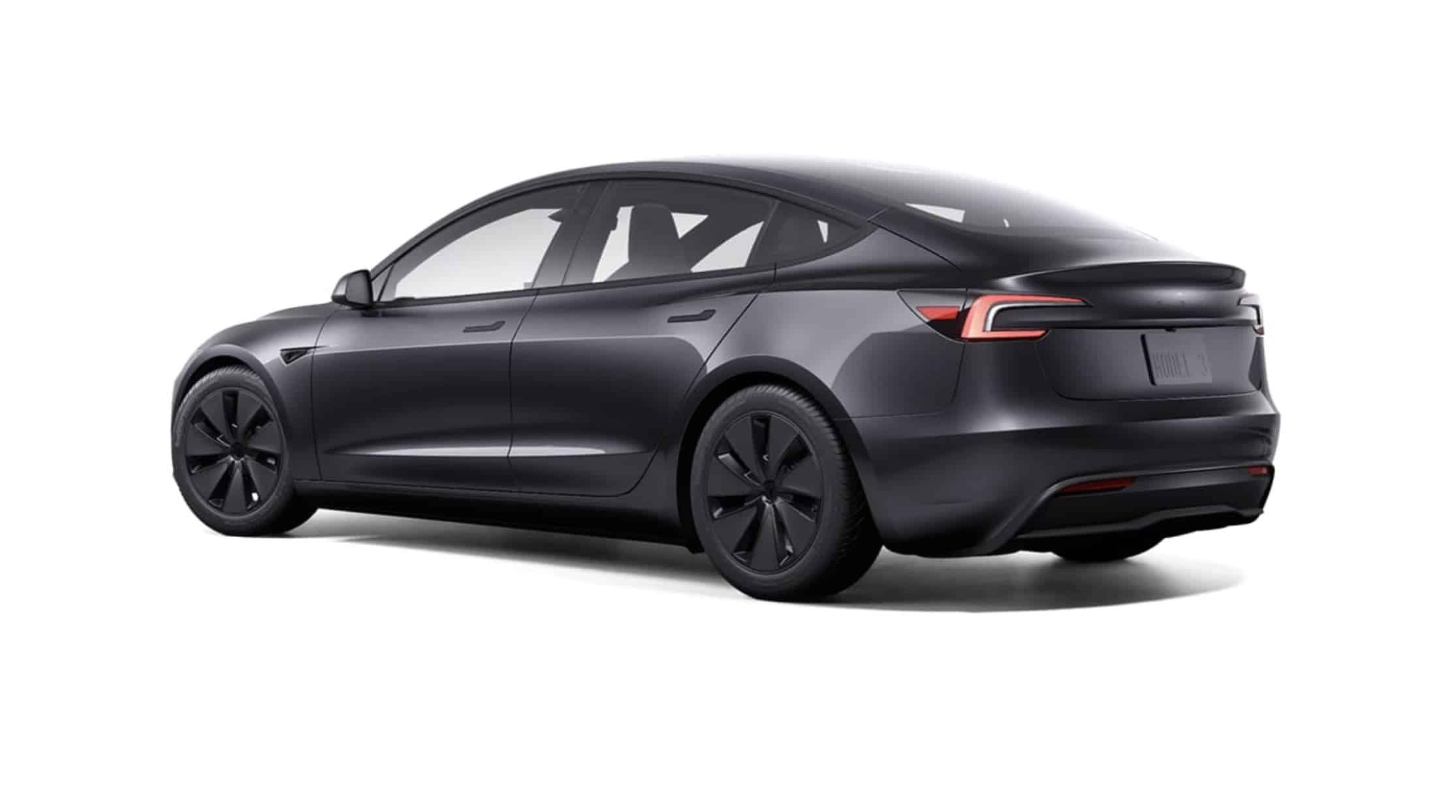
Tesla Model 3 Saloon (Credit: Tesla)
Pricing
The November 2026 UK cash-price comparison lists the Model 3 Rear-Wheel Drive from £37,990, Premium Long Range RWD from £44,990, Premium Long Range AWD from £49,990 and Performance from £59,990. Tesla’s dynamically updated configurator may apply optional wheels, paint, interior or finance incentives to the selected build, so a promotional monthly payment should not be confused with the full cash total. The prices shown below are dated starting points, not an independently confirmed checkout for every specification today.
| UK Model 3 derivative | Cash/OTR starting price (1 Nov 2026) | Range and purchase note |
|---|---|---|
| Model 3 Rear-Wheel Drive | £37,990 | 332 miles WLTP; five seats, single-motor RWD |
| Model 3 Premium Long Range RWD | £44,990 | Up to 466 miles WLTP; Premium equipment |
| Model 3 Premium Long Range AWD | £49,990 | Up to 410 miles WLTP; dual-motor traction |
| Model 3 Performance | £59,990 | Up to 354 miles WLTP; specialist chassis and wheels |
The figures are inclusive UK purchase-price examples sourced from the 1 November 2026 configurator record, not a price excluding registration and delivery. A buyer comparing finance should consider deposit, total payable, mileage allowances and the conditions of any Tesla promotion alongside insurance, VED and electricity costs. Request a current written order summary for the exact vehicle rather than relying on a screen capture of a different wheel or colour specification.
Specifications
The following four grouped tables cover the contemporary UK 2026 Model 3 family, not the early model retained in the historical article. Tesla’s published UK range, performance and warranty figures take precedence, while battery capacity and some 0–62 mph measurements are independently estimated and marked accordingly. Where a specification depends on wheel choice, charger capability or towing hardware, that condition is preserved rather than silently combined into a generic model figure.
| Battery, Emissions, Charging and Warranty | UK 2026 model/condition |
|---|---|
| Battery type | Lithium-ion high-voltage traction battery; chemistry differs by derivative and production version |
| Official gross/usable capacity | No consistently published UK manufacturer gross/usable kWh figures across the four derivatives |
| Independent estimated usable capacity | Approximately 58–60 kWh entry RWD; approximately 79 kWh Premium and Performance; independent estimates vary |
| RWD WLTP range | 332 miles, selected UK specification |
| Premium Long Range RWD WLTP | Up to 466 miles, version/wheel dependent |
| Premium Long Range AWD WLTP | Up to 410 miles, version/wheel dependent |
| Performance AWD WLTP | Up to 354 miles, version/wheel dependent |
| DC maximum — entry RWD | Up to 175 kW on suitable Supercharger/DC equipment under appropriate battery conditions |
| DC maximum — Premium/Performance | Up to 250 kW peak; not a constant rate throughout charging |
| DC 10–80% duration | Tesla does not publish one universal time for all four UK variants; charger/battery dependent |
| AC on-board charging | Up to 11 kW three-phase with suitable connection; typically up to ~7.4 kW at UK single-phase homes |
| Connectors | Type 2 AC and CCS-compatible DC for UK/European-specification vehicles |
| Vehicle warranty | 4 years or 60,000 miles, whichever occurs first; Tesla UK terms apply |
| Battery/drive warranty — RWD | 8 years or 100,000 miles, with minimum 70% battery capacity retention subject to terms |
| Battery/drive warranty — Premium/Performance | 8 years or 120,000 miles, with minimum 70% battery capacity retention subject to terms |
| Euro NCAP | Five stars (May 2025); applicability includes RWD, Long Range and Performance variants in RHD/LHD scope |
| Tailpipe emissions | 0 g/km CO₂ |
Tesla’s peak DC power should not be used as an average rate for a complete public charging session, and its miles-added-in-15-minutes claims reflect specific assumptions about efficiency and charging conditions. The battery estimates are contextual research figures, not precise manufacturer certification, so ownership cost examples should use a defined quantity of energy rather than claim an exact full-charge bill. Battery warranty eligibility remains subject to Tesla’s detailed written conditions.
| Illustrative UK Home-Charging Cost | Assumptions and checked calculations |
|---|---|
| Example energy delivered to battery | 60.0 kWh (illustrative energy addition, not official battery capacity) |
| Assumed charging efficiency | 90% AC wall-to-battery; actual losses vary |
| Electricity purchased at meter | 60.0 ÷ 0.90 = 66.67 kWh (rounded) |
| Illustrative standard unit rate | 25p/kWh, example tariff only |
| Illustrative standard cost | 66.67 kWh × £0.25 = £16.67 |
| Illustrative overnight unit rate | 7p/kWh, example tariff only |
| Illustrative off-peak cost | 66.67 kWh × £0.07 = £4.67 |
| Excluded costs | Standing charges, charger installation, tariff restrictions, preconditioning and other home electricity |
These calculations represent adding 60 kWh to a battery at an assumed 90% efficiency; they are not estimates of every version’s complete 0–100% charge. The electricity tariff is illustrative and may not be available for all hours or households. Actual cost will depend on energy added, ambient temperature, losses, tariff rules and any additional charge-management equipment required at home.
| Dimensions and Practicality | Current European owner-manual measurements |
|---|---|
| Length — RWD/Long Range | 4,720 mm |
| Length — Performance | 4,724 mm |
| Width excluding / including mirrors | 1,850 / 2,089 mm |
| Width with mirrors folded | 1,933 mm |
| Height — RWD/Long Range | 1,440 mm |
| Height — Performance | 1,431 mm |
| Wheelbase | 2,875 mm |
| Seating | Five, in all four UK variants |
| Rear boot behind second row | 594 litres |
| Front luggage compartment | 88 litres |
| Combined front + rear volume | 682 litres with five passengers (not rear-boot-only volume) |
| Braked towing — eligible non-Performance | Up to 1,000 kg with approved package and plate limits |
| Braked towing — Performance | Up to 500 kg with approved compatible package, per Tesla UK accessory specification |
| Unbraked towing | Up to 750 kg under owner-manual conditions; check vehicle documentation and model-specific limitations |
Dimensions and luggage quantities are taken from the current European Model 3 owner information, rather than older saloon dimensions or US-market cargo definitions. A low boot opening is an everyday consideration even with useful stated capacity, particularly for large prams or bulky boxes. Towing restrictions are more severe for the Performance, and the actual vehicle plate and installed equipment always determine what can legally and safely be carried.
| Powertrain and Performance by Variant | Drivetrain | Power/torque | Tesla 0–60 mph | Independent 0–62 mph | Top speed | Maximum DC |
|---|---|---|---|---|---|---|
| Model 3 RWD | Single motor, RWD | Tesla UK does not publish a consistent output/torque table | 6.2 sec | Approx. 6.2 sec (independent) | 110 mph | 175 kW |
| Model 3 Premium Long Range RWD | Single motor, RWD | No uniform current Tesla UK PS/Nm table | 4.9 sec | Approx. 5.2 sec (independent) | 125 mph | 250 kW |
| Model 3 Premium Long Range AWD | Dual motor, AWD | No uniform current Tesla UK PS/Nm table | 3.8 sec | Approx. 4.0 sec (independent) | 125 mph | 250 kW |
| Model 3 Performance | Dual motor, AWD | Tesla advertises approx. 460 hp; torque not uniformly stated | 2.9 sec (rollout subtracted) | Approx. 3.4 sec (independent) | 163 mph | 250 kW |
The Tesla figures in the fourth column are manufacturer-advertised 0–60 mph measurements, whereas the next column contains independently sourced 0–62 mph estimates with a different speed target and potentially different launch procedures. The 2.9-second Performance figure removes rollout and is not directly comparable with all standing-start measurements. Where official UK motor output or torque is missing, no unsupported exact figure has been introduced for the other derivatives.
FAQs
| Question | Answer |
|---|---|
| What does the Tesla Model 3 cost in the UK? | The cited November 2026 starting cash price is £37,990 for entry RWD; options and promotions may change the final order total. |
| Which Model 3 derivatives are included? | RWD, Premium Long Range RWD, Premium Long Range AWD and Performance AWD. |
| What is the longest UK WLTP range? | Up to 466 miles for the Model 3 Premium Long Range RWD on the relevant UK specification. |
| What is the entry Model 3 range? | 332 miles WLTP for the current UK RWD specification; actual distance varies with conditions. |
| Does Tesla officially state battery sizes? | Not consistently as comparable gross and usable UK figures; approximately 58–79 kWh usable is an independent estimate, not Tesla certification. |
| Are all versions four-wheel drive? | No. Entry RWD and Premium Long Range RWD drive the rear wheels; Premium AWD and Performance use two motors. |
| How quickly can it charge? | Up to 175 kW DC for entry RWD and 250 kW for Premium/Performance under suitable battery and charger conditions. |
| Can the Model 3 charge at home? | Yes. Around 7.4 kW on a suitable UK single-phase installation or up to 11 kW with an appropriate three-phase AC supply. |
| What is the boot capacity? | Tesla lists 594 litres behind the rear seats and 88 litres in the front compartment, 682 litres combined. |
| Can a Model 3 tow a trailer? | Up to 1,000 kg braked for eligible RWD/AWD versions with approved hardware, versus up to 500 kg for Performance, subject to the vehicle plate. |
| Is the current Model 3 safe? | It earned five Euro NCAP stars in May 2025, and the published validity includes the relevant RWD, Long Range and Performance drivetrains. |
| What is the vehicle warranty? | Four years or 60,000 miles; battery and drive unit eight years/100,000 miles for RWD or 120,000 miles for Premium/Performance, subject to terms. |
| Is the 2.9-second Performance acceleration a standing-start result? | It is Tesla’s 0–60 mph figure with rollout subtracted, so compare test methodologies carefully. |
| Is this the same as the older e-zoomed Tesla Model 3 review? | No. This article covers current 2026 UK versions; the earlier article is a separate historical reference. |
| What should I check before ordering? | The selected wheels and certified range, purchase price, availability, warranty, charging access, tyre/insurance cost and any towing requirements. |
Prices and specifications reflect UK information cross-checked on 21 November 2026, with the quoted starting prices based on a dated 1 November configuration record. Tesla may change vehicle specification, options and promotional offers, so the final written order and vehicle-specific warranty are authoritative for the purchase. This is an independent editorial buying guide, not an e-zoomed firsthand road test.
While e-zoomed uses reasonable efforts to provide accurate and up-to-date information, some of the information provided is gathered from third parties and has not been independently verified by e-zoomed. While the information from the third party sources is believed to be reliable, no warranty, express or implied, is made by e-zoomed regarding the accuracy, adequacy, completeness, legality, reliability or usefulness of any information. This disclaimer applies to both isolated and aggregate uses of this information.
Featured Articles
<!–
Carousel
–>

Tesla Powerwall 3 Home Battery Storage: UK Price, Specifications, Solar & EV Charging Guide
The Tesla Model 3 is an electric five-seat saloon that prioritises efficiency, straightforward long-distance charging and a minimalist cabin. Its relatively low body gives it a different character from…

EV Extension Cables Explained: Risks, Safety, and Best Charging Practices
The Tesla Model 3 is an electric five-seat saloon that prioritises efficiency, straightforward long-distance charging and a minimalist cabin. Its relatively low body gives it a different character from…
All-Electric BMW i3 Neue Klasse (2026): UK Prices, Specs, Range & Buying Guide
The Tesla Model 3 is an electric five-seat saloon that prioritises efficiency, straightforward long-distance charging and a minimalist cabin. Its relatively low body gives it a different character from…
Featured Products
-
<!–
–>Sale!

Best-In-Class Home Solar Bundle Offer (440W All Black Jinko Solar 8 Panels + Sungrow Hybrid Inverter 3.6 kW): price includes product supply only
<!– –>
Original price was: £2,205.95.£2,150.95Current price is: £2,150.95. (Including VAT)
<!–
–>
<!– Term:
NEDC range:
Model Year:
Deposit: £
Miles Per AnnumSubject to status and conditions –>
Brand:SungrowJinko SolarCategory:Solar<!– –>
-
<!–
–>Sale!
Best-In-Class Home Solar Bundle Offer (440W All Black Jinko Solar 8 Panels + Sungrow Battery Storage 6.4 kWh + Sungrow Hybrid Inverter 3.6 kW): price includes product supply only
<!– –>
Original price was: £5,010.95.£4,800.95Current price is: £4,800.95. (Including VAT)
<!–
–>
<!– Term:
NEDC range:
Model Year:
Deposit: £
Miles Per AnnumSubject to status and conditions –>
Brand:SungrowJinko SolarCategory:Solar<!– –>
-
<!–
–>Sale!

Bundle Offer: SUNSYNK LifePO4 Home Battery Storage (5.32 kWh) + SUNSYNK Hybrid Inverter (3.6 kW/Single-Phase): price includes product supply only
<!– –>
Original price was: £3,345.95.£3,299.95Current price is: £3,299.95. (Including VAT)
<!–
–>
<!– Term:
NEDC range:
Model Year:
Deposit: £
Miles Per AnnumSubject to status and conditions –>
Brand:Sun SynkCategory:Battery Storage<!– –>
-
Bundle Offer: Tesla Powerwall 3 Home Battery Storage (13.5 kWh) + Gateway: price includes product supply only
<!– –>
£8,559.95 (Including VAT)
<!–
–>
<!– Term:
NEDC range:
Model Year:
Deposit: £
Miles Per AnnumSubject to status and conditions –>
Brand:TeslaCategory:Battery Storage<!– –>
-
<!–
–>Sale!
Custom-Made Single-Phase EV Charging Cable Type 2 to Type 2 (2m to 50m, 7.4 kW, 32 amp, Black)
<!– –>
Price range: £99.95 through £670.95 (Including VAT)
<!–
–>
<!– Term:
NEDC range:
Model Year:
Deposit: £
Miles Per AnnumSubject to status and conditions –>
Category:CablesType:Type 2Length (m):5 m7.5 m10 m3.5 m12.5 m15 m20 m17.5 m2 m22.5 m25 m30 m35 m40 m45 m50 mCurrent (amp):32 ampPhase:Single Phase (7.2kW)<!– –>
This product has multiple variants. The options may be chosen on the product page -
Untethered Ohme ePod Home Smart EV Charger (7.4 kW): price includes product only
<!– –>
£645.95 (Including VAT)
<!–
–>
<!– Term:
NEDC range:
Model Year:
Deposit: £
Miles Per AnnumSubject to status and conditions –>
Brand:OhmeCategory:EV Charging PointsCustomer type:ResidentialPower:7.4 kWCable:UntetheredPhase:Single Phase<!– –>


The post Tesla Model 3 (2026): UK Prices, Specs, Range & Buying Guide appeared first on Ezoomed.