
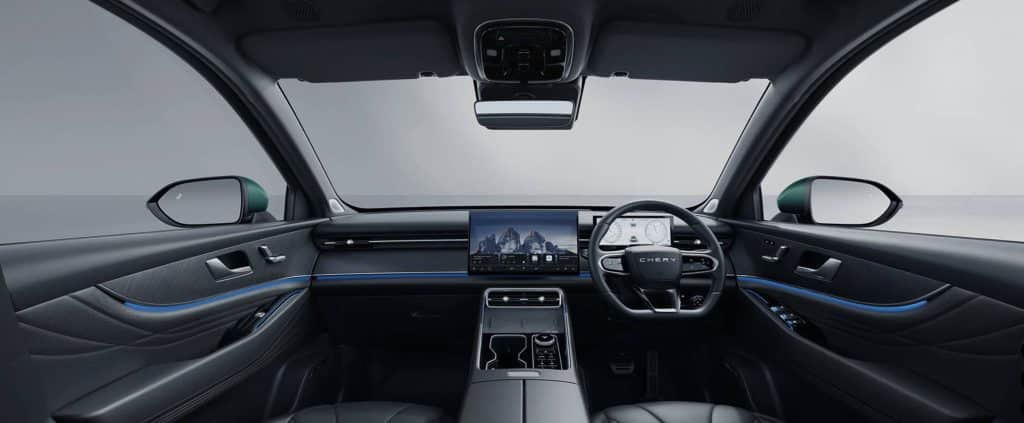
The Chery TIGGO 9 CSH (2026) is Chery’s flagship seven-seat family SUV for the UK, pairing a petrol engine with a rechargeable battery and electric motors. Unlike a fully electric car, it can run locally on electricity before using petrol on longer journeys. Its appeal lies in combining generous passenger accommodation, a lengthy official electric range and an unusually comprehensive standard-equipment package without the price of some established premium competitors.
British buyers are offered the TIGGO 9 CSH in Summit specification with a 1.5-litre turbocharged petrol engine, all-wheel drive and a combined 428 PS output according to the manufacturer’s UK data. The quoted electric-only range is up to 87 miles on the WLTP cycle, supported by a battery described as approximately 34.4 kWh. With a claimed 0–62 mph time of 5.4 seconds, the powertrain also offers considerable performance for a large, family-focused plug-in hybrid.
The UK model starts at £43,105 on the road according to Chery’s current listed price, with the exact transaction price depending on paint, availability and any applicable retailer offer. The Summit trim is positioned for households that need a genuine third row of seats but still want to complete school runs and commuting largely on electricity. Regular access to home charging is particularly important if buyers intend to benefit from its plug-in hybrid efficiency.
Its most relevant alternatives include the Kia Sorento Plug-in Hybrid, the Hyundai Santa Fe Plug-in Hybrid and other family SUVs offering seven seats. Buyers who do not need a third row may also consider the BYD SEAL U DM-i. Each competitor has a different combination of electric range, seating, ownership costs and equipment, making it worth comparing the whole package rather than headline performance alone.
This e-zoomed buying guide examines the TIGGO 9 CSH from a UK ownership perspective: electric driving, charging speeds, seven-seat practicality, available equipment, pricing, safety and warranty. It also explains why a laboratory-derived fuel-consumption figure should not be treated as typical petrol-only economy. Manufacturer claims and independently reported driving impressions are clearly distinguished, with unresolved certification details identified rather than presented as settled facts.
At a glance
| Specification | UK Chery TIGGO 9 CSH Summit (2026) |
|---|---|
| Powertrain | Plug-in Hybrid Electric Vehicle (PHEV); 1.5-litre turbo petrol + electric drive |
| UK starting price | £43,105 on the road (manufacturer website; check live quote) |
| Seating / body | Seven seats; large five-door SUV |
| Traction / transmission | All-wheel drive (AWD); dedicated hybrid automatic transmission |
| Battery capacity | 34.4 kWh quoted by Chery UK; 34.46 kWh in UK specification databases (gross/usable distinction to verify) |
| Official electric range | Up to 87 miles WLTP (manufacturer UK figure) |
| Manufacturer-estimated combined range | Up to 650 miles (not a guaranteed WLTP all-fuel range) |
| Combined system output / torque | 428 PS / 580 Nm |
| 0–62 mph / maximum speed | 5.4 seconds / 112 mph (reported UK specification) |
| Home AC charging | Approx. 6.6 kW; charge time depends on starting battery level |
| Rapid DC charging | Up to 71 kW; around 20 minutes from 30–80% claimed by Chery |
| Luggage volume | 143 L (seven seats in use); 819 L (third row folded); 2,065 L (rear rows folded) |
| Safety rating | Euro NCAP rating for this model: not established at research date |
| Official weighted CO₂ | UK databases report 14 g/km, while other reports show 38 g/km; registration-specific confirmation required |
| Manufacturer warranty | 7 years/100,000 miles vehicle; 8 years/100,000 miles high-voltage battery; terms apply |
Figures are UK-market headline data checked in November 2026. The electric range is a laboratory result and the 470 mpg weighted WLTP value assumes the regulatory plug-in hybrid test cycle, not continuous driving with a depleted battery. The exact CO₂ certification, usable battery capacity and selected vehicle’s final on-the-road price should be confirmed in the retailer’s current written specification.
Table of Contents
Pros & cons
| Pros | Cons |
|---|---|
| 1. Long electric-only capability. The manufacturer quotes 87 WLTP miles, enabling many regular journeys to be completed without using petrol when the battery is charged. | 1. Unexceptional driver engagement. Independent reviews suggest light steering and a comfort-led chassis that is less rewarding on demanding roads. |
| 2. Seven seats and generous specification. A useful third row, panoramic roof, massaging front seats and premium audio strengthen the value proposition. | 2. Small boot with all seats occupied. The quoted 143-litre luggage area calls for compromises when seven people are travelling. |
| 3. Rapid-charging PHEV flexibility. Unlike most plug-in hybrids, the car supports DC charging, helping replenish electric range during a suitable stop. | 3. High reliance on touch controls. Some frequently used functions are screen-led, and the model does not yet have a confirmed independent Euro NCAP result. |
Sign up to the e-zoomed Electric Living newsletter
About Chery: the company behind the TIGGO 9 CSH
Chery is a Chinese automotive manufacturer established in 1997, with international operations and multiple export markets. Its UK passenger-car range includes conventionally powered models and the Chery Super Hybrid family, which uses a plug-in hybrid layout designed to prioritise electric driving under suitable conditions. The TIGGO 9 CSH sits above the smaller family models in this portfolio, offering an additional emphasis on seven-seat accommodation, premium features and all-wheel-drive performance.
The brand’s broader background is outlined in the public Chery company overview, but UK buyers should focus on the local retailer network, parts support and exact warranty terms for the vehicle they purchase. Chery quotes seven years or 100,000 miles of vehicle warranty coverage and eight years or 100,000 miles for the high-voltage battery, subject to written conditions. A long warranty improves reassurance, but it cannot replace independent reliability evidence over several years.
Meet the Chery TIGGO 9 CSH
Overview
The TIGGO 9 CSH is designed around the needs of larger households rather than the priorities of a conventional sporting SUV. It combines three rows of seating, a substantial rechargeable battery and a petrol engine that can extend journeys beyond the battery’s available electric range. The result is a vehicle that behaves much like an electric car on shorter trips when charged, while retaining fuel-stop flexibility on motorways and family holidays.
In UK Summit form, the equipment specification is notably comprehensive and the purchase choice is relatively straightforward because Chery lists one principal trim and powertrain combination. That simplicity removes much of the usual confusion over entry-level versions and expensive feature packages, although individual paint finishes may add to the invoice. The choice is therefore more about whether the vehicle’s size, technology and real-world charging routine match your household than about selecting between multiple performance derivatives.
Anyone comparing the TIGGO 9 CSH with a fully electric seven-seater, such as the Kia EV9, should be clear about the fundamental difference: a PHEV continues to burn petrol after the electric reserve is reduced. It may suit families who frequently need a third row but cannot yet rely on convenient charging for every long journey. Conversely, drivers with reliable home charging and a preference for eliminating tailpipe emissions entirely may find a battery-electric alternative more appropriate.
Battery & range
According to Chery’s UK data, the TIGGO 9 CSH uses a battery of approximately 34.4 kWh and offers up to 87 miles of electric-only driving under WLTP conditions. UK third-party technical records describe a 34.46 kWh battery, a level of precision that should not be confused with confirmed usable energy. Battery management reserves capacity to protect the pack, so a quoted nominal or gross figure does not directly determine how much electricity a driver can replenish from empty to full.
The manufacturer also describes up to 650 miles of total driving range when electric energy and petrol are considered together. This combined claim is useful as broad context for touring ability but depends strongly on initial charge level, fuel quantity and driving conditions; it should not be read as a guaranteed distance between stops. For more context on how certified electric range varies between plug-in hybrid models, see the long-range plug-in hybrid guide from e-zoomed.
Chery quotes an eye-catching 470 mpg figure under the weighted WLTP plug-in hybrid procedure, which represents a prescribed mix of electric and petrol operation. It does not mean the car will travel 470 miles on one gallon with a discharged battery. Separate UK specification records give charge-sustaining fuel consumption around 6.9 litres per 100 km, approximately 40.9 mpg, illustrating why regular plugging in is central to the model’s potential running-cost advantage.
Charging
For regular UK ownership, the simplest arrangement is overnight AC charging at home using a compatible dedicated charging point. UK vehicle data lists an approximately 6.6 kW onboard AC charging rate, so a more powerful 7.4 kW home unit cannot force the vehicle to accept more than its own limit. The source specification quotes around 319 minutes from 0–100% under one test scenario, but actual time will vary with charge level, battery temperature and available electrical supply.
The TIGGO 9 CSH is unusual among plug-in hybrids because it also accepts DC rapid charging through a CCS-compatible connection. Chery advertises up to 71 kW and around 20 minutes for a 30–80% recharge in controlled conditions; some UK technical listings quote approximately 25 minutes for the same nominal percentage window. Drivers should allow for differences between peak charging power and the average delivered during a session, as well as possible waiting time at the charging station.
Families new to plug-in vehicles can use the beginners’ charging guide to understand home and public options, while the AC-versus-DC charging explanation clarifies why rapid charging works differently from a wallbox. The car’s connector specification, cable supplied and any adapter or accessory requirements should be confirmed for the exact UK vehicle at handover. Charging availability is not equivalent to a guaranteed charge rate at every public charger.
For cost planning, charging 20 kWh into the battery at an illustrative electricity rate of 25p per kWh and 90% charging efficiency requires approximately 22.2 kWh from the meter, costing £5.56. This is an arithmetic example rather than a published running cost or a claim about usable battery capacity. The actual tariff and charging losses matter; the EV charging-time guide gives further context on how power and battery size interact.
Practicality
The headline advantage is the TIGGO 9 CSH’s ability to carry seven occupants in a three-row SUV body. Chery states that the boot holds 143 litres with every seat raised, increasing to 819 litres when the third row is folded and 2,065 litres with the second and third rows stowed. These numbers underline the trade-off: the car may accommodate a full family, but seven people’s holiday luggage could require careful packing or a different travel arrangement.
Independent UK driving reports suggest that adults can use the rearmost seats for at least some journeys, although ease of access, child-seat installation and available legroom should always be assessed in person. The second row offers a more generous environment for regular use, while the third row is best judged with the family members who will actually sit there. Buyers who need seven seats frequently can also compare the seven-seat electric and electrified vehicle guide.
UK technical listings give exterior dimensions of approximately 4,810 mm long, 1,925 mm wide without mirrors and 1,741 mm high, with a 2,800 mm wheelbase. At this size the TIGGO 9 CSH is more comfortable in a spacious parking bay than in a narrow urban street, although camera assistance helps with manoeuvring. The quoted 11.2-metre turning circle is relatively manageable for a large SUV, but driveway and garage measurements remain sensible before ordering.
A powered tailgate, panoramic roof and configurable rear seating increase day-to-day convenience, and the high driving position should appeal to buyers moving from smaller crossovers. The electric-drive system is also relevant to practical ownership because repeated short trips can be undertaken without starting the petrol engine when operating conditions permit. It remains important to check permitted towing mass, towbar availability, payload and roof-loading limits against the actual UK vehicle approval and intended accessories.
Technology & equipment
Summit specification places considerable emphasis on cabin features, including a large 15.6-inch central display, digital driver information and a 14-speaker Sony audio system with speakers integrated into the front headrests. Chery also highlights heated and ventilated seats, front massage functions, wireless phone charging and ambient lighting. Much of this is unusually generous at the entry price, though buyers should inspect the controls themselves to establish which functions are easy to operate while driving.
The “Hello Chery” voice assistant, smartphone connectivity and a surround-view camera system are intended to reduce everyday effort, particularly in a vehicle with large exterior dimensions. Independent reports praise the amount of equipment but question the dependence on the touchscreen for routine tasks. A lengthy test drive is therefore important, including making climate adjustments, using navigation and checking whether warning messages or menu layouts distract from the road.
Vehicle-to-load functionality is also reported for the UK TIGGO 9 CSH, allowing a compatible output system to power suitable external electrical devices. Independent UK specifications describe an output capability of up to 6.6 kW, but users must confirm authorised accessories, operating limits and safe connection requirements with Chery. This capability is different from an approved home-backup installation and should not be used as a substitute for one without manufacturer and electrical-professional guidance.
Performance
The combination of the 1.5-litre turbo petrol engine and electric drive delivers a claimed 428 PS and 580 Nm, transmitted through an all-wheel-drive hybrid system. Chery quotes 0–62 mph in 5.4 seconds, while UK specification listings indicate a maximum speed of approximately 112 mph. These figures are remarkable for a seven-seat SUV focused on family comfort, although the instant electric response is likely to be more relevant in everyday overtaking and junction manoeuvres than the standing-start time.
Independent reviews generally describe the TIGGO 9 CSH as smooth and quiet when travelling under electric power, with the petrol engine joining in unobtrusively in many situations. The handling, however, is characterised as comfort-oriented, with light steering and less engagement than some established rivals. That character is not necessarily a drawback for a family car, but enthusiastic drivers should test it over uneven roads, roundabouts and faster bends before deciding whether the suspension and steering balance is suitable.
Running the car primarily on electricity requires consistent charging behaviour rather than relying on the petrol engine to maintain a depleted battery. Drivers comparing other electrified SUVs, such as the Volkswagen Tiguan eHybrid, should examine real electric range, motorway economy and comfort alongside straight-line performance. The larger battery is valuable when charged regularly, but its mass remains onboard after the usable electric reserve has been reduced.
Safety
The TIGGO 9 CSH is advertised with ten airbags and a broad suite of driver-assistance features including emergency braking, adaptive cruise assistance, blind-spot monitoring and lane-support technology. These features can help manage specific hazards but do not replace attentive driving or establish the car’s crash-test performance by themselves. Chery’s equipment claims should be checked against the exact UK Summit specification, particularly where software or market configuration can affect how an individual system behaves.
As of this research in November 2026, an independent Euro NCAP crash-test rating specifically for the UK TIGGO 9 CSH could not be established. Ratings for other Chery models should not be transferred to the TIGGO 9 CSH, even if some underlying technology is related. Families with young children should also confirm ISOFIX locations, child-restraint compatibility and usable third-row access in the physical vehicle rather than assuming every seating position is equally suitable.
Chery states that the high-voltage battery is monitored by dedicated protective systems and provides an eight-year or 100,000-mile battery warranty, subject to conditions. The wider seven-year or 100,000-mile vehicle warranty is attractive on paper, but exact component exclusions and servicing requirements can affect coverage. Before signing, request current written warranty terms and check how local authorised service support would work throughout the ownership period.
The verdict
The TIGGO 9 CSH is a compelling proposition for a family that wants seven seats, a substantial official electric range and extensive equipment without moving into a much more expensive premium SUV. Its formula is practical: use electricity for routine journeys and retain petrol capability for longer trips. The strongest argument is not simply its impressive acceleration or headline economy, but the combination of space, charging flexibility and features at its UK on-the-road price.
The most convincing strengths are the 87-mile WLTP electric-only claim, the generous specification and the flexibility of DC charging in a plug-in hybrid. The cabin includes features often reserved for costly option packs elsewhere, while the third row offers additional carrying capacity when required. For buyers who regularly recharge at home, the electric portion of the drivetrain could cover a significant share of everyday mileage, although conditions will alter the distance achieved.
There are meaningful reservations. Independent feedback points to steering that prioritises ease over engagement, considerable reliance on touchscreen controls and a relatively small 143-litre boot when all seven seats are occupied. The lack of a verified model-specific Euro NCAP rating at the time of research also merits an explicit caveat. These issues do not negate the value case, but they should be explored on a realistic test drive rather than overlooked because the equipment list is long.
Charging access is central to the ownership decision because the high official weighted fuel-economy figure is not representative of continuous petrol-mode operation. The battery needs frequent replenishment to deliver the savings implied by the PHEV format, and public rapid charging may not always be convenient or inexpensive. A household with a driveway and an appropriate home tariff is better placed to exploit the technology than one which must rely exclusively on public charging.
The TIGGO 9 CSH competes with familiar seven-seat plug-in hybrid SUVs, as well as fully electric family vehicles that make a different compromise between upfront price and fuel flexibility. Buyers should compare the usable rearmost seats, real boot space, warranty conditions, and the cost of their own typical journeys. There is no universal winner: one family may value the Chery’s equipment and electric range, while another may prioritise an established dealer network or a battery-electric drivetrain.
Value will ultimately depend on the full written purchase quotation, insurance premium, finance terms and how often the vehicle runs on electric power. Chery’s listed £43,105 on-the-road entry point is competitive for its size and equipment, but promotional savings or alternative retailer prices must not be confused with the manufacturer’s standard list price. Owners should also budget for servicing, tyres and electricity or petrol rather than relying on a single official combined-mpg figure.
Overall, e-zoomed considers the TIGGO 9 CSH worthy of a shortlist for UK households seeking a comfortable, comprehensively equipped seven-seat PHEV with flexible charging. The recommendation is strongest for families that can charge frequently, accept the screen-heavy controls and require occasional rather than constant maximum luggage volume. Confirm the registration-specific CO₂ figure, warranty paperwork and final specification before ordering, and compare a properly equipped rival on the same total-ownership-cost basis.
Gallery
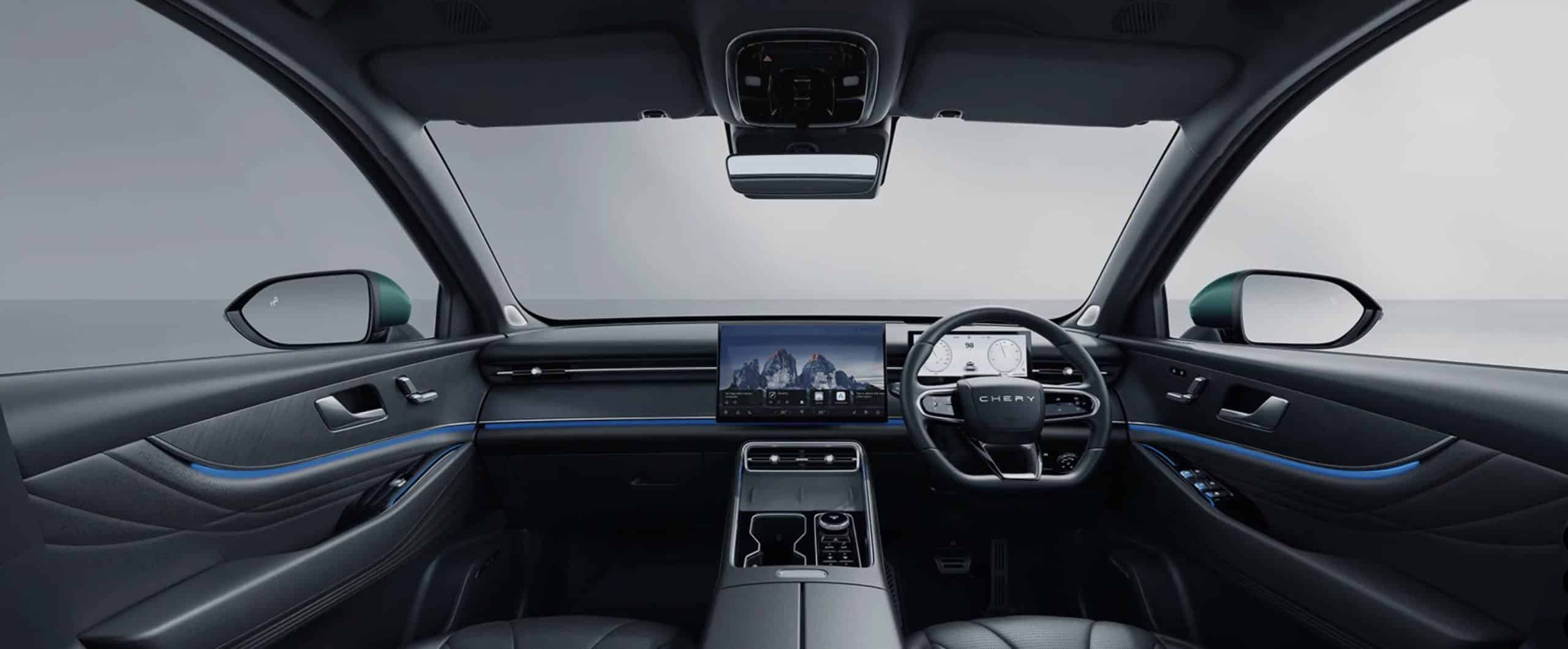
Chery TIGGO 9 CSH Plug-in Hybrid (Credit: Chery)
Pricing
The Chery UK website lists the TIGGO 9 CSH Summit from £43,105 on the road as of November 2026. A separate UK model database lists a £42,990 RRP, which is not the same price basis as Chery’s £43,105 OTR quote and should be reconfirmed for the chosen registration. Summit combines the seven-seat body, plug-in hybrid all-wheel-drive powertrain and broad standard equipment package; no second UK trim or independently verified alternative drivetrain was identified in the accessible current manufacturer information.
Individual paint finishes may carry a surcharge and finance or dealer incentives can change during the ordering period. Published independent price schedules indicate that Arctic White Mist is the included finish, with some alternative colours priced separately, but the exact current selection and invoice should be confirmed directly with the retailer. A written quote should distinguish vehicle list price, on-the-road charges, optional paint, finance costs and any time-limited contribution before buyers compare competing offers.
| UK version | Manufacturer-listed starting price | Notes |
|---|---|---|
| Chery TIGGO 9 CSH 1.5T PHEV Summit AWD | £43,105 OTR | Chery current manufacturer UK site; seven seats; 428 PS; 87-mile WLTP electric range |
| Published UK RRP comparator | £42,990 RRP | Third-party UK listing, not independently confirmed as the current manufacturer RRP |
| Optional paint / accessories | Confirm in current UK quote | No surcharge assumed without selected configuration |
| Finance / promotional price | Variable | Do not treat time-limited incentives as the permanent on-the-road list price |
Specifications
The tables below distinguish the UK manufacturer’s figures from values corroborated by current UK vehicle-specification records. The quoted 34.4–34.46 kWh is a nominal capacity and should not be presented as verified usable energy; similarly, electric range and charging windows depend on the test method and conditions. The manufacturer’s current 87-mile WLTP figure takes precedence over older or differently labelled third-party claims of approximately 91 miles unless Chery confirms a revised UK homologation result.
| Battery, emissions and warranty | UK Summit specification / qualification |
|---|---|
| Vehicle type | Plug-in Hybrid Electric Vehicle (PHEV); petrol and rechargeable electric drivetrain |
| Battery capacity | Approx. 34.4 kWh (Chery); 34.46 kWh UK data; usable capacity N/A |
| Electric-only range | Up to 87 miles WLTP, according to Chery UK |
| Combined driving range | Up to 650 miles; manufacturer estimate, not guaranteed |
| Official weighted combined fuel consumption | Approx. 470 mpg WLTP; plug-in hybrid laboratory procedure |
| Charge-sustaining fuel consumption | Approx. 6.9 L/100 km / 40.9 mpg from UK vehicle database; not Chery’s weighted figure |
| Weighted combined CO₂ | UK records show 14 g/km; another UK review states 38 g/km; obtain exact vehicle CoC before certification |
| Vehicle warranty | 7 years or 100,000 miles, whichever first; conditions apply |
| High-voltage battery warranty | 8 years or 100,000 miles; manufacturer conditions and battery health provisions apply |
| Charging data | UK Summit value / context |
|---|---|
| AC charging interface | Type 2; onboard AC rate approximately 6.6 kW |
| AC 0–100% | 319 minutes (~5 h 19 min) in reported UK standard test scenario |
| DC charging interface | CCS; manufacturer peak claim up to 71 kW |
| DC 30–80% | Chery quotes around 20 minutes; some UK listings state 25 minutes |
| Charging cost | Based on the household’s actual tariff, grid energy and session losses; see illustration below |
| Illustrative home charging top-up | Energy from meter at 90% efficiency | Cost at 25p/kWh |
|---|---|---|
| 10 kWh added to battery | 11.11 kWh | £2.78 |
| 20 kWh added to battery | 22.22 kWh | £5.56 |
| 30 kWh added to battery | 33.33 kWh | £8.33 |
Home-charge illustration: electricity from the meter equals the battery energy replenished divided by an assumed 0.90 charging efficiency. The examples therefore use 10/0.90, 20/0.90 and 30/0.90 kWh, each multiplied by an illustrative £0.25/kWh tariff. They are not predictions of a full usable-battery charge, because the UK usable capacity has not been independently established and the actual electricity tariff, losses and charging window will differ.
| Dimensions and practicality | UK vehicle data |
|---|---|
| Length × width × height | 4,810 × 1,925 × 1,741 mm (width excludes mirrors) |
| Width including mirrors | Approximately 2,223 mm |
| Wheelbase | 2,800 mm |
| Kerb weight | Approximately 2,233 kg |
| Turning circle | 11.2 m |
| Seating / boot with seven seats | 7 seats / 143 L |
| Boot with third row folded | 819 L |
| Maximum quoted luggage volume | 2,065 L (rear rows folded) |
| Braked towing capacity | Up to 1,500 kg in UK data; confirm approved towbar/vehicle rating |
| Fuel tank | 70 L in UK technical listings |
| Powertrain and performance | UK Summit value |
|---|---|
| Petrol engine | 1,499 cc turbocharged four-cylinder |
| Electrified system | Plug-in hybrid with dedicated hybrid transmission |
| Driven wheels | All-wheel drive |
| Combined power / torque | 428 PS / 580 Nm according to manufacturer UK model page |
| 0–62 mph / maximum speed | 5.4 seconds / approx. 112 mph |
| Tyres / wheels | 245/50 R20 on 20-inch alloy wheels (reported UK fitment) |
| Driver assistance | Chery advertises ten airbags and sixteen assistance features |
| Euro NCAP | TIGGO 9-specific rating not independently established as of 18 Nov 2026 |
FAQs
| Question | Answer |
|---|---|
| Is the Chery TIGGO 9 CSH fully electric? | No. It is a Plug-in Hybrid Electric Vehicle (PHEV) combining a rechargeable battery and electric motors with a petrol engine. |
| How much does it cost in the UK? | Chery lists the Summit from £43,105 on the road; obtain an up-to-date quote for options and finance. |
| What is its official electric range? | Up to 87 miles WLTP according to the current manufacturer UK model page; driving conditions will affect real distance. |
| How many seats does it offer? | Seven. There are three rows, but luggage volume is 143 litres with every seat occupied. |
| How large is the battery? | Chery describes approximately 34.4 kWh; UK technical records show 34.46 kWh. Usable energy is not independently confirmed. |
| Can the TIGGO 9 CSH use DC rapid chargers? | Yes. Chery quotes up to 71 kW and approximately 20 minutes from 30–80% in controlled conditions. |
| How long does AC home charging take? | A UK data listing gives around 319 minutes for a full 0–100% AC charging session at the model’s quoted charging capability. |
| Does it have all-wheel drive? | Yes. The UK Summit combines a petrol-electric drivetrain with AWD and a claimed system output of 428 PS. |
| What is its Euro NCAP rating? | No model-specific Euro NCAP rating was independently confirmed during this November 2026 research; do not assume the rating of another Chery model. |
| How long is the warranty? | Chery quotes seven years/100,000 miles vehicle cover and eight years/100,000 miles battery cover, subject to terms. |
| Is the quoted 470 mpg typical when the battery is flat? | No. It is a weighted WLTP PHEV laboratory result. Charge-sustaining consumption is markedly higher, so plugging in regularly matters. |
| What is its CO₂ figure? | UK data sets differ between 14 and 38 g/km weighted results. Confirm the exact registration’s official certificate before making a tax or emissions decision. |
Editorial update: 18 November 2026. UK specification, availability, pricing, certification and warranty information may change; buyers should obtain the current written retailer quotation and registration-specific documentation. The e-zoomed article is an independently prepared buying guide and does not represent an original hands-on vehicle test.
While e-zoomed uses reasonable efforts to provide accurate and up-to-date information, some of the information provided is gathered from third parties and has not been independently verified by e-zoomed. While the information from the third party sources is believed to be reliable, no warranty, express or implied, is made by e-zoomed regarding the accuracy, adequacy, completeness, legality, reliability or usefulness of any information. This disclaimer applies to both isolated and aggregate uses of this information.
Featured Articles
<!–
Carousel
–>

Mazda CX-60 Plug-In Hybrid: UK Prices, Specs, Range & Buying Guide
The Chery TIGGO 9 CSH (2026) is Chery’s flagship seven-seat family SUV for the UK, pairing a petrol engine with a rechargeable battery and electric motors. Unlike a fully…

Type 2 to Type 2 EV Charging Cable: Compatible Electric Cars & Guide
The Chery TIGGO 9 CSH (2026) is Chery’s flagship seven-seat family SUV for the UK, pairing a petrol engine with a rechargeable battery and electric motors. Unlike a fully…

Best Plug-In Hybrid SUVs
The Chery TIGGO 9 CSH (2026) is Chery’s flagship seven-seat family SUV for the UK, pairing a petrol engine with a rechargeable battery and electric motors. Unlike a fully…
Featured Products
-
<!–
–>Sale!

Best-In-Class Home Solar Bundle Offer (440W All Black Jinko Solar 8 Panels + Sungrow Hybrid Inverter 3.6 kW): price includes product supply only
<!– –>
Original price was: £2,205.95.£2,150.95Current price is: £2,150.95. (Including VAT)
<!–
–>
<!– Term:
NEDC range:
Model Year:
Deposit: £
Miles Per AnnumSubject to status and conditions –>
Brand:SungrowJinko SolarCategory:Solar<!– –>
-
<!–
–>Sale!
Best-In-Class Home Solar Bundle Offer (440W All Black Jinko Solar 8 Panels + Sungrow Battery Storage 6.4 kWh + Sungrow Hybrid Inverter 3.6 kW): price includes product supply only
<!– –>
Original price was: £5,010.95.£4,800.95Current price is: £4,800.95. (Including VAT)
<!–
–>
<!– Term:
NEDC range:
Model Year:
Deposit: £
Miles Per AnnumSubject to status and conditions –>
Brand:SungrowJinko SolarCategory:Solar<!– –>
-
<!–
–>Sale!

Bundle Offer: SUNSYNK LifePO4 Home Battery Storage (5.32 kWh) + SUNSYNK Hybrid Inverter (3.6 kW/Single-Phase): price includes product supply only
<!– –>
Original price was: £3,345.95.£3,299.95Current price is: £3,299.95. (Including VAT)
<!–
–>
<!– Term:
NEDC range:
Model Year:
Deposit: £
Miles Per AnnumSubject to status and conditions –>
Brand:Sun SynkCategory:Battery Storage<!– –>
-
Bundle Offer: Tesla Powerwall 3 Home Battery Storage (13.5 kWh) + Gateway: price includes product supply only
<!– –>
£8,559.95 (Including VAT)
<!–
–>
<!– Term:
NEDC range:
Model Year:
Deposit: £
Miles Per AnnumSubject to status and conditions –>
Brand:TeslaCategory:Battery Storage<!– –>
-
<!–
–>Sale!
Custom-Made Single-Phase EV Charging Cable Type 2 to Type 2 (2m to 50m, 7.4 kW, 32 amp, Black)
<!– –>
Price range: £99.95 through £670.95 (Including VAT)
<!–
–>
<!– Term:
NEDC range:
Model Year:
Deposit: £
Miles Per AnnumSubject to status and conditions –>
Category:CablesType:Type 2Length (m):5 m7.5 m10 m3.5 m12.5 m15 m20 m17.5 m2 m22.5 m25 m30 m35 m40 m45 m50 mCurrent (amp):32 ampPhase:Single Phase (7.2kW)<!– –>
This product has multiple variants. The options may be chosen on the product page -
Untethered Ohme ePod Home Smart EV Charger (7.4 kW): price includes product only
<!– –>
£645.95 (Including VAT)
<!–
–>
<!– Term:
NEDC range:
Model Year:
Deposit: £
Miles Per AnnumSubject to status and conditions –>
Brand:OhmeCategory:EV Charging PointsCustomer type:ResidentialPower:7.4 kWCable:UntetheredPhase:Single Phase<!– –>

The post Chery TIGGO 9 CSH Plug-in Hybrid (2026): UK Prices, Specs, Range & Buying Guide appeared first on Ezoomed.