
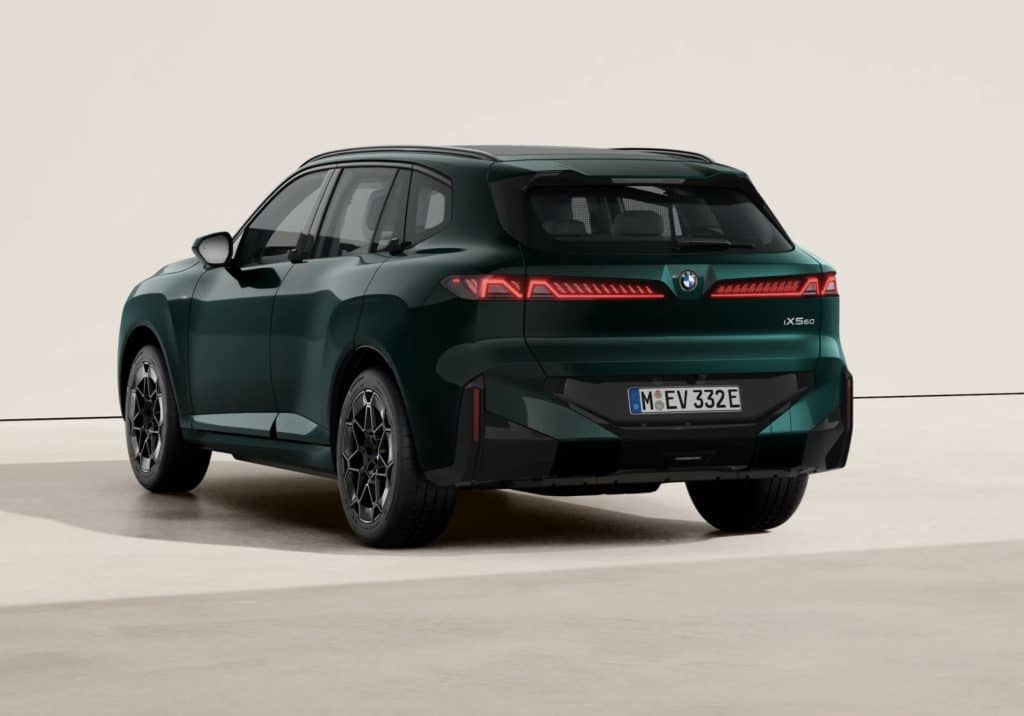
The BMW iX5 brings battery-electric power to one of BMW’s most familiar luxury SUVs, rather than asking buyers to move to an unfamiliar body style. Due to reach the UK in spring 2027, it combines the generous accommodation of the X5 family with sixth-generation electric-drive technology and a substantial battery. Its £85,375 starting price means the appeal will be strongest among buyers already considering a large, premium SUV for family use and long-distance travel.
The UK launch range consists of the BMW iX5 60 xDrive, BMW iX5 60 xDrive M Sport and BMW iX5 60 xDrive M Sport Pro, all using the same 141.2 kWh stated battery capacity and 425 kW dual-motor drivetrain. BMW’s current UK technical data gives provisional WLTP combined ranges of 475–512 miles for the standard car and 474–528 miles for M Sport. The headline 460 kW DC charging capability is impressive, but it is a peak figure requiring unusually capable infrastructure and favourable battery conditions.
The new model is important because it adds a fully electric option to the wider X5 family alongside combustion-engine and plug-in hybrid alternatives, with UK deliveries expected from spring 2027. Buyers should distinguish the battery-electric BMW iX5 from the separately developed BMW iX5 Hydrogen fuel-cell project: they are not interchangeable versions of the same charging system. For the electric launch model, BMW has confirmed five seats, a large rear boot and useful front storage, with optional towing capability for appropriately specified vehicles.
Among UK alternatives, the Volvo EX90 prioritises a different family-oriented approach, while the Polestar 3 provides another premium electric SUV with a performance emphasis. Within BMW’s own range, the BMW iX3 Neue Klasse is a smaller, less expensive electric-SUV option. These are meaningful comparisons, but their seating arrangements, specifications and prices differ; choosing by maximum advertised range alone would overlook the practical compromises each presents.
This guide examines what BMW has actually confirmed for the UK as of 18 November 2026, including equipment grades, current prices, battery and charging data, practicality, safety and running costs. It explains where BMW’s figures are provisional, where the published technical pages disagree with older launch material, and why the final ordered specification matters. The aim is to help prospective owners decide whether the BMW iX5 offers the right combination of capability, comfort and value without implying that e-zoomed has conducted its own road test.
At a glance: BMW iX5 (2027)
| Specification | UK BMW iX5 60 xDrive range |
|---|---|
| UK OTR prices | £85,375–£91,525 (three equipment grades) |
| Market launch | Expected spring 2027 |
| EV type | Battery-Electric Vehicle (BEV) |
| Body style / seats | Large SUV / five |
| Battery | 141.2 kWh (BMW published battery-capacity figure) |
| WLTP combined range | 475–512 miles standard; 474–528 miles M Sport (provisional) |
| Drivetrain / power | Dual-motor AWD / 425 kW (578 hp) |
| Torque / 0–62 mph | 805 Nm / provisional 4.6 seconds |
| Top speed | 130 mph (electronically limited) |
| AC charging | Up to 22 kW; equipment and supply dependent |
| DC charging | Up to 460 kW; about 22 minutes, 10–80% in specified conditions |
| Luggage | 655–1,850 litres rear; 53-litre front compartment |
| Braked towing | Up to 2,700 kg with appropriate equipment |
| Euro NCAP | No model-specific rating verified at research date |
| Tailpipe emissions | 0 g CO₂/km |
According to BMW’s current UK technical data and November 2026 UK pricing, checked on 18 November 2026. Range and acceleration figures are provisional and may change with certification, wheel specification and options. BMW’s current technical page lists different range bands for the standard and M Sport cars; the M Sport Pro-specific range should be checked against the final configuration. Charging figures assume suitable infrastructure and battery conditions.
Table of Contents
Pros & cons
| Pros | Cons |
|---|---|
| 1. Long-range potential. Provisional WLTP figures reach 528 miles in a suitable configuration, reducing the need to stop frequently on longer journeys. | 1. Premium purchase price. Starting above £85,000, the electric X5 requires a considerable budget even before optional equipment and ownership costs. |
| 2. Rapid-charging engineering. The 800-volt system offers up to 460 kW DC and a manufacturer-stated 22-minute 10–80% charge in favourable conditions. | 2. Size and mass. A body nearly five metres long and a stated 2,900 kg kerb weight create parking, efficiency and manoeuvring compromises. |
| 3. Genuine touring practicality. Five seats, 655 litres of luggage space, a front compartment and up to 2,700 kg towing capacity when appropriately equipped. | 3. Charging infrastructure constraints. Few everyday chargers can supply the quoted peak DC power, while the large battery takes considerable time to refill on a typical UK home supply. |
Sign up to the e-zoomed Electric Living newsletter
About BMW: The company behind the BMW iX5
BMW is a German manufacturer with its headquarters in Munich and a long-established premium-car business spanning cars, motorcycles and associated services. Its electric portfolio has expanded from earlier urban and executive models into larger SUVs, supported by new vehicle software and battery technology. Background on the company is available from BMW, although current UK manufacturer specifications and contractual terms remain the appropriate references for purchasing decisions.
The BMW iX5 is significant because it introduces a battery-electric drivetrain into the familiar X5 family, with conventional and plug-in hybrid variants continuing alongside it. BMW’s new 800-volt architecture and sixth-generation high-voltage battery system are central to the change, but these technologies do not remove the practical limitations of a large and heavy vehicle. UK buyers should also distinguish the rechargeable BMW iX5 from the planned hydrogen fuel-cell vehicle bearing a related name, which will have different infrastructure and ownership considerations.
Meet the BMW iX5
Overview
The new BMW iX5 retains the upright, substantial proportions expected of an X5 while introducing battery-electric propulsion, a redesigned interior and newer BMW digital systems. It is intended for buyers seeking familiar large-SUV versatility rather than a compact, efficiency-first electric vehicle. With a five-seat cabin and generous luggage area, it suits drivers who regularly carry passengers and equipment, although its considerable width and length make it a less natural choice for tight city parking.
For the UK launch, there is one electric drivetrain offered through standard, M Sport and M Sport Pro equipment grades, not three progressively larger batteries. The standard model is the price reference, while the more expensive grades change appearance and equipment; BMW’s current technical information also distinguishes the published wheel-dependent WLTP range bands. Buyers should therefore compare the full configuration and included features rather than assume that the most expensive trim automatically provides the greatest range or stronger motors.
A useful way to assess the BMW iX5 is to separate its engineering capability from actual ownership benefit: an enormous battery may reduce charging frequency, but it also increases the energy needed for a full refill. The vehicle’s luggage space and optional towing capacity could matter more to some households than its 4.6-second acceleration claim. Where possible, prospective buyers should drive a final UK production example to judge visibility, comfort, turning circle and the usability of the digital controls before choosing options.
Battery & range
BMW lists a battery-capacity figure of 141.2 kWh for all three UK electric launch configurations, integrated into the floor and paired with sixth-generation electric-drive technology. The capacity supports impressive provisional WLTP figures, but the exact result depends on trim, wheels and other equipment. Current BMW UK technical data gives 475–512 miles for the standard BMW iX5 60 xDrive and 474–528 miles for BMW iX5 60 xDrive M Sport, with a definitive M Sport Pro configuration requiring retailer confirmation.
These figures come from a standardised combined test cycle rather than a promise of motorway range, so drivers should expect variations in cold weather, on sustained high-speed journeys or with a heavily loaded vehicle. Heating and cooling, terrain, tyre choice and driving habits can all materially affect the distance available between stops. BMW’s older announcement material sometimes quotes a lower maximum, and some portions of its consumer-facing pages still carry that earlier figure; the newer UK technical data is the basis used here, with its provisional qualification preserved.
The potential benefit for a long-distance driver is the freedom to choose stops for convenience rather than charge at every available service area. However, a 141.2 kWh battery also requires substantial energy when depleted, so efficient planning and access to reasonably priced electricity will remain important. Those driving mostly short daily distances may find that the largest range number adds less everyday value than it would for owners regularly covering several hundred miles in a day.
The published battery-capacity figure should not be confused with a guaranteed amount of energy deliverable at every temperature or state of health. Protection buffers and battery-management behaviour can influence the energy accessible to the vehicle, while ageing and operating conditions may gradually affect usable range. Buyers should examine the final owner documentation and battery warranty terms, particularly if they expect to keep the car for many years or cover unusually high annual mileage.
Charging
The BMW iX5 uses an 800-volt electrical architecture with a quoted maximum DC charging rate of 460 kW, one of the most striking figures in the specification. BMW currently states a minimum approximately 22-minute 10–80% charge in favourable test conditions, while some earlier information referred to roughly 23 minutes. Neither figure means the battery accepts its peak power throughout a charging session; the real charging curve varies with temperature, state of charge, charger capability and battery preparation.
An ordinary 150 kW or 350 kW public charger cannot provide the car’s advertised 460 kW maximum, although charging remains possible at compatible lower-power equipment. What matters on a journey is the availability of a reliable charger, the power it can actually deliver and how long the vehicle sustains a useful charging rate. The AC and DC EV charging guide explains the difference between charger ratings and the electrical conversion involved, while the CCS charging guide covers the rapid-charging connector used by European EVs.
BMW quotes maximum AC charging of 22 kW and about seven and a half hours for a full 0–100% session at that power under specified conditions, subject to equipment and an appropriate electrical supply. Most UK homes use single-phase connections, with a typical dedicated EV charger capable of about 7.4 kW rather than 22 kW, so a near-empty battery will take much longer to replenish. The guide to how long EV charging takes provides a useful framework for understanding why onboard charging capability and the property’s electricity connection both matter.
For owners who can charge overnight, topping up the battery regularly will generally be more convenient than routinely waiting for an empty-to-full refill. Long-distance planning should account for charging costs and availability as well as speed; networks differ in access requirements, pricing and provision for non-member vehicles. Our Tesla Supercharger network guide is one starting point for checking the wider landscape, but compatibility and access at any particular station must be verified before travel.
Practicality
At 4,994 mm long for the standard UK version, 2,000 mm wide without mirrors and 1,748 mm high, the BMW iX5 is a sizeable SUV rather than a modest family crossover. BMW gives a 3,035 mm wheelbase and an overall width of 2,216 mm including mirrors, which is especially relevant for urban parking and narrow access routes. A five-seat interior provides ample room for occupants, but there is no confirmed seven-seat electric configuration in the initial UK pricing information.
According to BMW’s technical data, the rear luggage area holds 655 litres with the seats in their normal position and up to 1,850 litres when configured for maximum load space. The additional 53-litre front compartment offers a separate place for smaller bags or accessories and helps avoid filling the main boot with charging equipment. This combination could suit families who regularly carry sports gear, luggage or bulky items, provided the vehicle’s loading limits are respected.
The available towing specification reaches up to 2,700 kg braked with the necessary equipment, but buyers should confirm the rated trailer weight, towbar installation and maximum nose load on the exact vehicle ordered. Towing will increase energy consumption, and the effect can be considerable with a tall caravan or heavy trailer. The published 2,900 kg kerb weight also makes it important to check payload and any applicable road or parking restrictions rather than assuming every location can comfortably accommodate the vehicle.
Technology & equipment
BMW has fitted the new X5 family with a more digitally integrated cabin, with its latest interface intended to simplify information, navigation and the interaction between vehicle systems. For the BMW iX5, the key ownership advantages should be clear charging information, route guidance and control of comfort systems, rather than the mere presence of larger displays. Drivers should still test whether regularly used controls are intuitive and accessible while moving, especially when changing from a previous-generation X5.
The UK price list identifies three electric equipment grades, but standard features and optional extras can differ between them. BMW highlights equipment such as passenger displays, comfort upgrades and driver-assistance technologies, with availability depending on the selected configuration. Before ordering, buyers should compare the detailed specification for their chosen version and ask the supplying BMW Centre to confirm its included options, wheel sizes and any associated effect on the final price or WLTP range.
BMW also promotes connected charging, journey planning and bidirectional-energy functionality for the new electric SUV, although the availability and practical use of such capabilities can depend on hardware, software, market and compatible home equipment. These features may eventually add value for households with smart electricity tariffs or energy-management systems, but prospective buyers should ask which functions are supported at UK delivery. Our UK beginner’s electric-car charging guide explains the everyday charging basics that remain relevant even with advanced onboard software.
Performance
The BMW iX5 60 xDrive has a front-and-rear electric motor system producing a manufacturer-stated 425 kW (578 hp) and 805 Nm of maximum torque. BMW quotes provisional 0–62 mph acceleration in 4.6 seconds and an electronically limited top speed of 130 mph, placing it among genuinely quick large SUVs. These are manufacturer performance figures rather than independent e-zoomed test results, and the available power does not change the car’s significant size and mass.
Electric all-wheel drive can distribute propulsion between the axles in response to conditions, while the lack of a conventional multi-speed gearbox should make progress feel smooth. Early independent impressions indicate strong acceleration and polished responses, but real-world ride quality is likely to be affected by wheels, tyres, suspension options and road surface. Buyers should consider how a nearly three-tonne SUV behaves on narrow British roads or over poor surfaces, not only how quickly it reaches motorway speeds.
The different UK equipment grades share the same quoted powertrain, so a higher trim should not be chosen on the assumption that it automatically brings a faster or more powerful electric motor. More relevant distinctions may include wheel diameter, cabin finishes, seating comfort, driver-assistance options and the effect of equipment on range. For many buyers, effortless overtaking and quiet long-distance cruising will be more valuable than repeatedly exploiting the maximum acceleration figure.
Safety
The BMW iX5 is aimed partly at families and long-distance travellers, making occupant protection, outward visibility and predictable driver-assistance behaviour important buying considerations. BMW describes a modern suite of vehicle-control and assistance functions, but exact standard UK fitment depends on the chosen equipment grade and options. Buyers should verify which systems are genuinely included rather than assume every feature demonstrated on a manufacturer display vehicle comes with the £85,375 version.
No model-specific Euro NCAP assessment for the new all-electric BMW iX5 was independently confirmed during research for this article on 18 November 2026. Safety scores earned by other BMW SUVs cannot simply be transferred to this larger model, even where some technologies or design approaches are shared. When a rating becomes available, buyers should check the tested variant, assessment year and individual category scores instead of treating a five-star badge as a complete substitute for the results.
The SUV’s high mass, substantial acceleration and possible towing duties make correct tyre selection, loading and braking-system care particularly important. Assistance systems are designed to support an attentive driver and do not remove responsibility for safe control or route choice. A handover at the supplying BMW Centre should cover the limitations of any lane, cruise, parking and collision-assistance features fitted to the particular car, as well as relevant settings for towing or carrying heavy loads.
The verdict
The BMW iX5 gives BMW customers a genuinely large electric SUV with an established X5 identity, rather than a smaller model expected to serve the same role. Its usable accommodation, high performance and impressive charging architecture make it a credible premium option for long journeys and family life. The technology is ambitious, but its real advantage will depend on the final UK configuration and how easily an owner can access affordable charging.
The main strengths are the substantial 141.2 kWh battery, provisional range reaching 528 miles in the relevant UK specification, and the potential for a short high-power charging stop when conditions are right. A 655-litre boot, separate front storage and available towing capacity help give those impressive numbers a practical purpose. For a family travelling frequently across the country, this combination is potentially more useful than performance figures alone.
The price, weight and charging infrastructure are the most obvious compromises. Starting at £85,375 OTR, the BMW iX5 is expensive even before buyers consider insurance, taxation and equipment, while its size will not suit every driveway or parking space. The headline 460 kW DC power rating is also a capability rather than a charging speed owners can expect from ordinary public chargers.
The standard BMW iX5 60 xDrive is the logical starting point for buyers interested primarily in the electric drivetrain and the X5 body style. It has the same headline battery capacity and dual-motor power as the M Sport grades, leaving equipment and appearance as the principal reasons to spend more. Buyers should compare its actual included equipment carefully, but there is no need to assume the entry model is compromised by a smaller battery.
The BMW iX5 60 xDrive M Sport and BMW iX5 60 xDrive M Sport Pro cost £3,980 and £6,150 more than the standard model respectively, based on November 2026 UK OTR prices. Those differences may be justified by the appearance and equipment selected, but they do not buy a fundamentally different electric drivetrain. Some choices can also influence the WLTP figure, making a clear, vehicle-specific quotation particularly important.
The e-zoomed view: The BMW iX5 deserves consideration by buyers who genuinely need a large luxury SUV and can make regular use of home charging or dependable high-power public infrastructure. Its appeal lies in combining everyday space with long-distance flexibility, not simply in winning a contest for the highest headline charging number. We would place practicality, final equipment and real charging arrangements ahead of marginal differences in quoted acceleration.
Before ordering, obtain BMW’s latest written UK specifications for the selected grade, check its individual provisional or certified WLTP range and ask for the full OTR quotation with options. Confirm battery warranty conditions, home charging suitability, delivery timing and whether desired connected-energy features will be usable at handover. A production-vehicle test drive should provide the final judgement on comfort, visibility, ride quality and whether this sizeable electric SUV is worth its premium cost.
Gallery
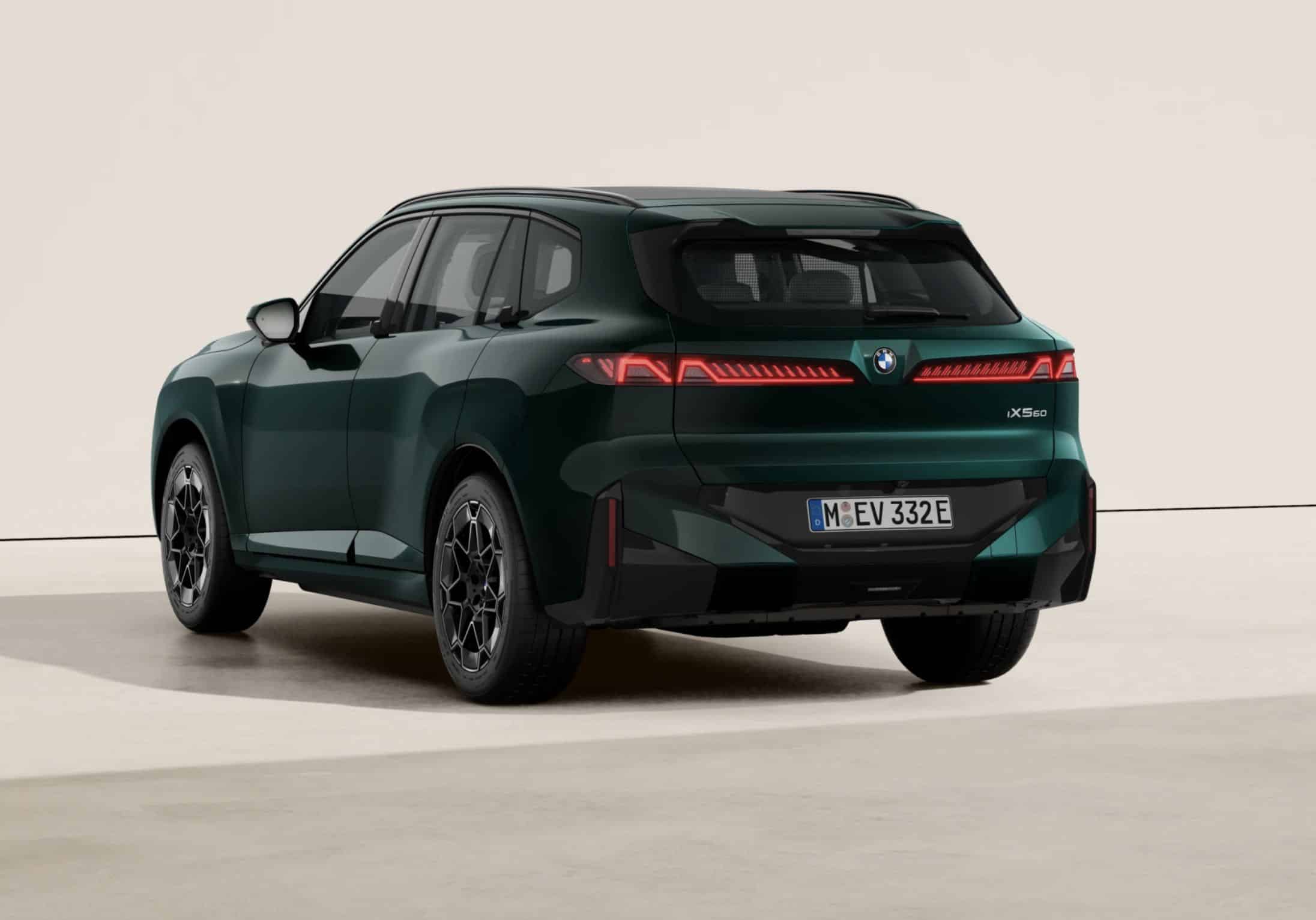
All-Electric BMW iX5 (Credit: BMW)
Pricing
BMW’s November 2026 UK pricing document lists the fully electric BMW iX5 in three equipment grades with on-the-road prices from £85,375 to £91,525. The manufacturer separately distinguishes its recommended retail price including VAT from the OTR price, which is £1,005 higher for each of these electric variants in the published schedule. The figures below are manufacturer list prices rather than binding personal quotations, and additional equipment or later price changes may affect the final contract.
| UK electric version | RRP incl. VAT | OTR price |
|---|---|---|
| BMW iX5 60 xDrive | £84,370 | £85,375 |
| BMW iX5 60 xDrive M Sport | £88,350 | £89,355 |
| BMW iX5 60 xDrive M Sport Pro | £90,520 | £91,525 |
Moving from the standard version to M Sport adds £3,980 OTR; M Sport Pro adds a further £2,170, bringing the overall increase to £6,150. All three prices relate to the same launch electric drivetrain, so the differences should be assessed against the chosen trim’s appearance and equipment rather than presented as separate battery options. Buyers should also consider insurance, servicing, relevant Vehicle Excise Duty charges, any applicable expensive-car supplement and the cost of domestic or public electricity before evaluating affordability.
Specifications
BMW’s latest UK technical page is the primary reference for the following figures, with model-year and configuration differences preserved rather than merged into a misleading single specification. Acceleration and WLTP values are described as provisional where the manufacturer has not yet confirmed final certification. The newer 474–528-mile M Sport figure differs from earlier BMW announcements and from some older text still carried on the main model page; the newer technical table is used consistently here.
| Battery, emissions and warranty | UK information / qualification |
|---|---|
| Electric powertrain | Battery-Electric Vehicle (BEV), dual-motor AWD |
| Battery capacity | 141.2 kWh (BMW published figure) |
| Electrical system | 800-volt architecture |
| WLTP standard 60 xDrive | 475–512 miles, provisional |
| WLTP M Sport | 474–528 miles, provisional |
| WLTP M Sport Pro | Check final configuration-specific value |
| Tailpipe emissions | 0 g CO₂/km |
| New-vehicle warranty | BMW UK new-car warranty terms; confirm in writing |
| High-voltage battery warranty | BMW UK BEV terms: 8 years / 100,000 miles, qualifying conditions |
| Battery capacity coverage | Subject to BMW UK warranty booklet terms |
| Charging equipment / performance | BMW published maximum or condition |
|---|---|
| Connector | Type 2 AC / CCS DC |
| AC charging | Up to 22 kW, vehicle and supply dependent |
| AC 0–100% at 22 kW | Minimum approximately 7 h 30 min in specified conditions |
| Typical UK single-phase wallbox | Around 7.4 kW where supported |
| DC peak | Up to 460 kW with compatible infrastructure |
| DC 10–80% | Minimum approximately 22 min, specified conditions |
| High-power charging added range | BMW quotes 185–226 miles in 10 minutes, configuration/test dependent |
| Dimensions and capability | Standard/UK specification |
|---|---|
| Length | 4,994 mm standard / 4,998 mm M Sport |
| Width, excluding mirrors | 2,000 mm |
| Width, including mirrors | 2,216 mm |
| Height | 1,748 mm |
| Wheelbase | 3,035 mm |
| Kerb weight | 2,900 kg (manufacturer stated) |
| Seats | 5 |
| Rear luggage volume | 655–1,850 litres |
| Front storage | 53 litres |
| Braked trailer limit | Up to 2,700 kg when suitably equipped |
| Trailer nose weight | Up to 110 kg where applicable |
| Performance | 60 xDrive electric drivetrain |
|---|---|
| Power | 425 kW (578 hp) |
| Torque | 805 Nm |
| Drive | Electric all-wheel drive |
| Transmission | Single-speed automatic |
| 0–62 mph | 4.6 s, provisional |
| Maximum speed | 130 mph (limited) |
Home charging costs depend on the price paid for electricity and losses between the meter and the battery, not just the vehicle’s battery size. To make the arithmetic transparent, the next table assumes an illustrative domestic tariff of 25p/kWh and 90% charging efficiency, applied to BMW’s 141.2 kWh capacity figure. It does not represent a BMW charging quote, a fixed UK electricity tariff or a prediction of actual energy consumption in every charging session.
| Illustrative home charge | Estimated cost at 25p/kWh, 90% efficiency |
|---|---|
| 0–100% of 141.2 kWh | £39.22 |
| 10–80% of 141.2 kWh | £27.46 |
| Electricity tariff assumption | £0.25 per kWh |
| Charging efficiency assumption | 90% |
The full-charge example models approximately 156.89 kWh drawn from the supply (141.2 divided by 0.90), which costs £39.22 at the illustrative tariff. A 10–80% charge replaces 70% of the nominal capacity and models approximately 109.82 kWh from the supply, costing £27.46 on the same basis. For actual ownership planning, compare standing charges, peak and off-peak prices and access to discounted overnight electricity using our UK electric-car charging-tariff guide.
FAQs
| Question | Answer |
|---|---|
| How much does the BMW iX5 cost? | From £85,375 OTR for the UK 60 xDrive; M Sport £89,355 and M Sport Pro £91,525 in BMW’s November 2026 schedule. |
| When does the BMW iX5 arrive in Britain? | BMW expects the UK market launch in spring 2027; individual deliveries require retailer confirmation. |
| What is its provisional WLTP range? | BMW currently quotes 475–512 miles for standard 60 xDrive and 474–528 miles for M Sport; confirm final configuration-specific values. |
| How large is the battery? | BMW’s UK technical data lists 141.2 kWh. |
| How quickly can it charge? | Up to 460 kW DC and approximately 22 minutes from 10–80% under specified favourable conditions; real-world charging varies. |
| Can I use a UK home wallbox? | Yes, with appropriate installation and compatible equipment; a typical 7.4 kW single-phase home supply charges much more slowly than 22 kW AC. |
| Does it have seven seats? | The current launch version is specified with five seats. |
| Can it tow? | Up to 2,700 kg braked with appropriate options and within the exact vehicle limits. |
| Does it have Euro NCAP stars? | No model-specific independent Euro NCAP rating was verified at the 18 November 2026 research cut-off. |
| What does BMW’s UK battery warranty cover? | Published BMW UK BEV terms specify up to eight years or 100,000 miles with exclusions and capacity-protection conditions; confirm the contract for the ordered vehicle. |
The figures above describe the vehicle as currently documented rather than a guarantee that every option or operating condition produces the same result. Prospective customers should verify the latest UK technical information, written pricing and applicable warranty documents before ordering. The BMW iX buying guide offers further context for readers comparing BMW’s larger electric SUVs, although the two vehicles have different drivetrains and specifications.
While e-zoomed uses reasonable efforts to provide accurate and up-to-date information, some of the information provided is gathered from third parties and has not been independently verified by e-zoomed. While the information from the third party sources is believed to be reliable, no warranty, express or implied, is made by e-zoomed regarding the accuracy, adequacy, completeness, legality, reliability or usefulness of any information. This disclaimer applies to both isolated and aggregate uses of this information.
Featured Articles
<!–
Carousel
–>
Electric Car Salary Sacrifice UK: How It Works, Benefits & Tax Savings
The BMW iX5 brings battery-electric power to one of BMW’s most familiar luxury SUVs, rather than asking buyers to move to an unfamiliar body style. Due to reach the…
All-Electric BYD Sealion 7: UK Prices, Specs, Range & Buying Guide
The BMW iX5 brings battery-electric power to one of BMW’s most familiar luxury SUVs, rather than asking buyers to move to an unfamiliar body style. Due to reach the…
All-Electric XPENG G6 (2026): UK Prices, Specs, Range & Buying Guide
The BMW iX5 brings battery-electric power to one of BMW’s most familiar luxury SUVs, rather than asking buyers to move to an unfamiliar body style. Due to reach the…
Featured Products
-
<!–
–>Sale!
Best-In-Class Home Solar Bundle Offer (440W All Black Jinko Solar 8 Panels + Sungrow Hybrid Inverter 3.6 kW): price includes product supply only
<!– –>
Original price was: £2,205.95.£2,150.95Current price is: £2,150.95. (Including VAT)
<!–
–>
<!– Term:
NEDC range:
Model Year:
Deposit: £
Miles Per AnnumSubject to status and conditions –>
Brand:SungrowJinko SolarCategory:Solar<!– –>
-
<!–
–>Sale!
Best-In-Class Home Solar Bundle Offer (440W All Black Jinko Solar 8 Panels + Sungrow Battery Storage 6.4 kWh + Sungrow Hybrid Inverter 3.6 kW): price includes product supply only
<!– –>
Original price was: £5,010.95.£4,800.95Current price is: £4,800.95. (Including VAT)
<!–
–>
<!– Term:
NEDC range:
Model Year:
Deposit: £
Miles Per AnnumSubject to status and conditions –>
Brand:SungrowJinko SolarCategory:Solar<!– –>
-
<!–
–>Sale!
Bundle Offer: SUNSYNK LifePO4 Home Battery Storage (5.32 kWh) + SUNSYNK Hybrid Inverter (3.6 kW/Single-Phase): price includes product supply only
<!– –>
Original price was: £3,345.95.£3,299.95Current price is: £3,299.95. (Including VAT)
<!–
–>
<!– Term:
NEDC range:
Model Year:
Deposit: £
Miles Per AnnumSubject to status and conditions –>
Brand:Sun SynkCategory:Battery Storage<!– –>
-
Bundle Offer: Tesla Powerwall 3 Home Battery Storage (13.5 kWh) + Gateway: price includes product supply only
<!– –>
£8,559.95 (Including VAT)
<!–
–>
<!– Term:
NEDC range:
Model Year:
Deposit: £
Miles Per AnnumSubject to status and conditions –>
Brand:TeslaCategory:Battery Storage<!– –>
-
<!–
–>Sale!
Custom-Made Single-Phase EV Charging Cable Type 2 to Type 2 (2m to 50m, 7.4 kW, 32 amp, Black)
<!– –>
Price range: £99.95 through £670.95 (Including VAT)
<!–
–>
<!– Term:
NEDC range:
Model Year:
Deposit: £
Miles Per AnnumSubject to status and conditions –>
Category:CablesType:Type 2Length (m):5 m7.5 m10 m3.5 m12.5 m15 m20 m17.5 m2 m22.5 m25 m30 m35 m40 m45 m50 mCurrent (amp):32 ampPhase:Single Phase (7.2kW)<!– –>
This product has multiple variants. The options may be chosen on the product page -
Untethered Ohme ePod Home Smart EV Charger (7.4 kW): price includes product only
<!– –>
£645.95 (Including VAT)
<!–
–>
<!– Term:
NEDC range:
Model Year:
Deposit: £
Miles Per AnnumSubject to status and conditions –>
Brand:OhmeCategory:EV Charging PointsCustomer type:ResidentialPower:7.4 kWCable:UntetheredPhase:Single Phase<!– –>

The post All-Electric BMW iX5 (2027): UK Prices, Specs, Range & Buying Guide appeared first on Ezoomed.